


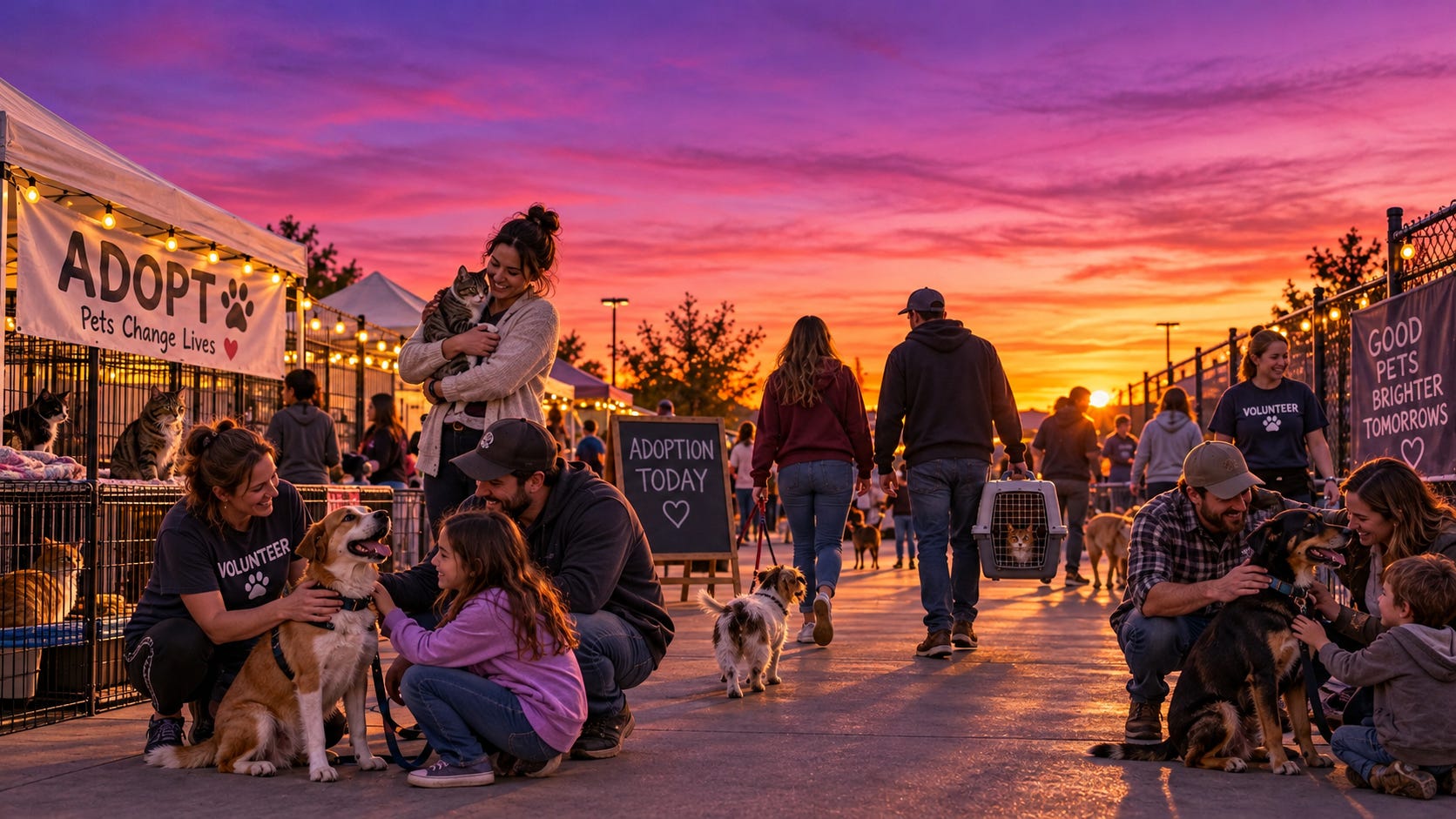
A former animal control officer told me something earlier this year that I have not been able to put down. She had worked the big waived-fee adoption events, the ones that clear a hundred animals out of a full building in a weekend, and she said the same animals kept coming back. Her phrase was rent-a-pet. People take a free dog, the novelty wears off, the dog comes back.
It is a common belief in this field. It is also, as far as the research goes, wrong. And the way it is wrong is more interesting than the belief.
The fee is not the variable
In 2009, Emily Weiss and Shannon Gramann published a comparison of adult cat adopters in the Journal of Applied Animal Welfare Science. Seventy-eight people paid a seventy-five dollar adoption fee. Ninety-five people paid nothing. Then they measured attachment.
No difference. Both groups scored the same on attachment, and both groups thought equally well of the shelter they adopted from. The study was done on cats, and the authors of a more recent review note there is little reason to expect dogs would behave differently, though nobody has run the dog version.
So the thing almost everyone believes, that paying for an animal makes you value it, did not show up when somebody went and looked.
Neither is the application
The second belief is that screening protects animals. If you check the landlord, require a meet-and-greet with the resident dog, ask the right questions on the form, you filter out the people who will fail.
Weiss and colleagues tested that too, in a 2014 study at a single Ohio shelter. One group of adopters went through the traditional process with landlord verification and required dog-to-dog introductions. The other group met basic requirements and had a conversation with staff. Ninety-six percent of the animals in the study were still in their homes at follow-up, and there was no difference in retention between the two groups. The authors’ own language is that policy-based approaches could be wasting effort.
It is a small study, a hundred and forty-two animals at one shelter, and the authors say so. But it points the same direction as the fee research. The gate is not where the outcome is decided.
Which leaves the question of what that officer was watching.
Returns are real
She was not imagining the returns. In 2021, Lauren Powell and colleagues published an analysis of 23,932 adoptions from Charleston Animal Society in South Carolina over five years. Within six months of adoption, 9.2 percent of those animals came back. For dogs it was 16.3 percent. For cats, 4.2 percent.
One dog in six. That is not a rounding error and it is not a story about bad people. It is a system producing a predictable failure rate, and the fee and the form are not what produce it.
So I went looking for the research on what does decide it.
Here is what I found, which is almost nothing
Best Friends published a literature review on adoptions last year. It covers the fee research, the open adoption research, deliberation time, breed labels, photographs, all of it. On post-adoption support programs and whether they change retention, it has no findings. Not weak findings. None. The only post-adoption measure anywhere in it is a thirty-day follow-up survey that one study used to count how many animals were still home, which is a measurement, not a support program.
The most serious attempt I can find to study this is from Dogs Trust in the United Kingdom. They enrolled 5,498 adopters across twenty centres and built a support structure of scripted calls at two days, two weeks, and four months, with veterinary and behaviour callbacks available. The paper describing it came out this year. It is a methods paper. It describes the cohort and the design and says the evaluation is still to come. Its own discussion says few studies have been able to evaluate whether interventions meant to reduce these risks work.
Read that again, because it is the whole piece. The largest structured attempt to support adopters after they go home is, as of this year, still at the stage of explaining how it will be measured.
And the clocks are set wrong
There is a second problem underneath the first one, and it is about when we look.
The open adoption study measured at thirty days. Powell measured returns within six months. An older American Humane retention study set its window at roughly six months as well. Those are the windows the field has chosen, and they were chosen because they are practical, not because anybody established that those are the months when families lose pets.
Think about what takes a pet out of a home. A lease comes up for renewal and the new one has a weight limit. A dog that was fine for two months starts resource guarding when the kids go back to school. Somebody loses hours at work in February. A vet bill arrives on a Friday night in the eleventh month. None of those are thirty-day events. Some of them are not six-month events.
We are measuring the window where the mismatch shows up, which is real and worth measuring, and calling it the window where the bond is decided. Those are not the same thing. A dog returned at three weeks because the behavior was misrepresented is a different failure from a family surrendering at fourteen months because the rent went up, and only one of them is in the data.
What the layer would have to be
If the fee does not decide it and the form does not decide it, then whatever decides it happens after the adopter drives away. Which means the infrastructure has to live there.
Three things, and I want to be careful about how I say this next part.
Honest behavior information at the point of adoption, so the adopter knows what they are taking home. Not a breed label, which predicts very little, but what the animal did in foster and in the shelter, written down. We call ours a Pet Resume.
Scheduled contact after the adoption rather than an open invitation to call if something goes wrong. People in trouble do not call. We run ours at seven days, thirty days, sixty days and ninety days, which is a structure borrowed from the Dogs Trust shape rather than invented.
And something to offer when the call surfaces a problem. A follow-up call that finds a family in a housing bind and has nothing to hand them is a satisfaction survey. The money for the emergency vet bill, the help with the pet deposit, the trainer for the resource guarding, those have to exist or the call is theater.
Now the careful part. I have just described a program we operate. I do not have evidence that it works. Nobody does, for any version of it, which is the entire point of this piece. I am not going to spend two months writing about numbers nobody sourced and then quietly imply my own program is proven. It is a hypothesis built on the shape of the problem, and it will stay a hypothesis until somebody runs it against a control group for longer than six months.
What I will say is that it is aimed at the part of the process where the research says the outcome is decided, and the field’s current effort is aimed at two places where the research says it is not.
Where waived-fee events sit
Back to where this started.
Waived-fee events are not an adoption strategy. They are a pressure release valve for a building that is over capacity, and judged as that, they work. Animals leave. Kennels open. Staff get a weekend where the euthanasia list is shorter. The research says those adopters are not worse than anybody else’s adopters, so the people who run these events have nothing to apologize for.
The problem is what happens when a pressure valve gets reported as a program. A hundred and twenty adoptions in a weekend is a capacity number, not an outcome, and the moment it goes in an annual report as an outcome, the organization has stopped measuring the thing that matters and started measuring the thing that is easy. Then the returns come in over the following months, land in a different line item, and nobody connects the two.
That is not a criticism of the events. It is a criticism of the scoreboard.
The part I keep coming back to
We spent fifteen years arguing about the adoption fee and the application form, and we were thorough about it. We ran the studies, we changed the policies, and the field is better for it. Open adoption is right and the evidence supports it.
And in all that time, the question of what happens to a family in month three got almost no attention at all, because it happens somewhere nobody counts, to people who have already left the building.
One dog in six comes back. We know almost nothing about why, and we have barely tried to find out.
Join the shift to prevention.
Donate to Prevention and fund what happens before the shelter.
Animal-Angels Foundation
angels@animal-angels.org
animal-angelsfoundation.org
Connect with us:
LinkedIn: linkedin.com/company/animalangels
Facebook: facebook.com/animalangelsfoun
Instagram: instagram.com/an.gels377
Animal-Angels Foundation Inc
A 501(c)(3) public charity
Tax ID 41-3166394
We welcome DAF and QCD gifts.
Serving Jefferson, Shelby, Blount, St. Clair, Walker, Bibb, and Chilton counties in Central Alabama.
Pet Help Desk: (205) 754-7542
Email: angels@animal-angels.org
Web: animal-angelsfoundation.org
Donate: animal-angelsfoundation.org/Donate.html
By Animal-Angels Foundation, a prevention-first 501(c)(3).
Sources
Weiss, E. and Gramann, S. A Comparison of Attachment Levels of Adopters of Cats: Fee-Based Adoptions versus Free Adoptions. Journal of Applied Animal Welfare Science, 12(4), 360-370, 2009. 78 fee-paying adopters versus 95 fee-waived; no difference in attachment or in view of the shelter.
Weiss, E., Gramann, S., Dolan, E.D., Scotto, J.E., Slater, M.R. Do Policy Based Adoptions Increase the Care a Pet Receives? An Exploration of a Shift to Conversation Based Adoptions at One Shelter. Open Journal of Animal Sciences, 4(5), 313-322, 2014. doi:10.4236/ojas.2014.45040. 96 percent still in home at follow-up; no difference in retention between policy-based and conversation-based groups.
Powell, L., Reinhard, C., Satriale, D., Morris, M., Serpell, J., Watson, B. Characterizing unsuccessful animal adoptions: age and breed predict the likelihood of return, reasons for return and post-return outcomes. Scientific Reports, 11, 8018, 2021. doi:10.1038/s41598-021-87649-2. 23,932 adoptions, Charleston Animal Society, 2015-2019; 9.2 percent returned within six months; dogs 16.3 percent, cats 4.2 percent.
Best Friends Animal Society. Literature review: Adoptions, May 2024. Covers fee-waived and open adoption research; contains no findings on post-adoption support programs or their effect on retention. https://bestfriends.org/sites/default/files/2025-09/Literature%20Review%20-%20Adoptions.pdf
Buckland, E.L., Giragosian, K., Jordan, E.J., Da Costa, R.E.P., Woodward, J.L., Casey, R.A. New Strategies of Canine Post-Adoption Support: Methods for a Prospective Longitudinal Cohort Study. Animals, 15(9), 1232, 2025. doi:10.3390/ani15091232. Dogs Trust UK; 5,498 adopters enrolled across 20 centres; scripted calls at 2 days, 2 weeks and 4 months; methods and cohort profile only, outcomes not yet reported.
American Humane, Animal Welfare Research Institute, with PetSmart Charities. Keeping Pets (Dogs and Cats) in Homes, Phase II: post-adoption retention across six shelters in three U.S. cities, retention measured at approximately six months after adoption, 2015.