


In the middle of September 2025, roughly two hundred dogs were living on one property in Giles County, Tennessee.
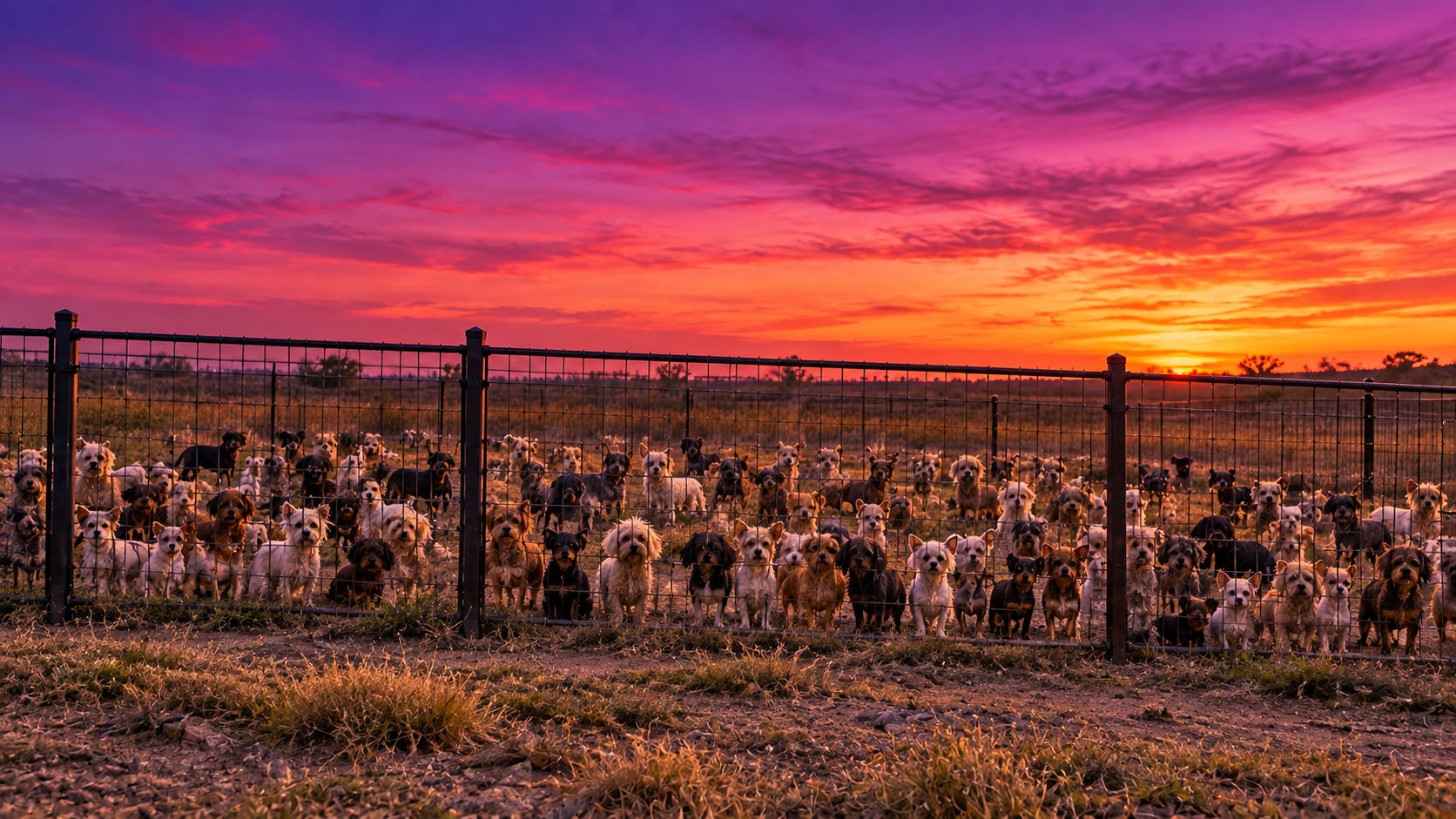
BISSELL Pet Foundation sent its Animal Incident Management team. The Giles County Animal Shelter worked the case with them. The Greater Birmingham Humane Society, across the state line in Alabama, took in more than a hundred and thirty of those dogs, most of them small-breed puppies, some weighing barely over a pound, most of them carrying giardia or coccidia or both. Birmingham news called it neglect. One station called it hoarding. The dogs were treated, sterilized, and placed.
It was a good response. It was fast, it was competent, three organizations in two states coordinated it without a turf fight, and a lot of dogs are alive and in homes because of it. I want that on the record before I say the next part, because the next part is not a criticism of any of it.
Not one thing in that response prevented a single litter.
Six days later
One of the dogs the humane society took in was pregnant.
On September 24, 2025, six days after the removal, she had a litter in Birmingham. Three days later somebody at the shelter put one of the puppies on a scale and wrote down 0.37 pounds. Just under six ounces.
That puppy is Cotton. I fostered her and her brother and her sister starting in early November, when they were six or seven weeks old. Her siblings were adopted. I adopted Cotton on December 12, 2025. The Animal-Angels Foundation’s effective date of exemption is December 17, 2025.
Five days.
I want to be careful about the shape of that, because it is tempting to tell it as a story about a dog changing somebody’s life. The useful version is less sentimental. I had been reading county budgets and shelter dashboards for a while and had already arrived at an argument. What the puppy did was make it impossible to keep treating that argument as a thing I would get to eventually.
Here is the part that took me until last week to see clearly, because I had my own dog’s story wrong in my own materials.
She was never on that property
Until last week, the bio we had written for Cotton said she survived a backyard breeding operation in Tennessee and was transported to Alabama. It is what we handed to anyone who asked, and it is what her page on our site was built from. I wrote it, or I approved it, and it is wrong twice.
She was born in Birmingham, in a shelter, six days after the removal. She never spent an hour of her life on that property. And no published record of the case calls it a breeding operation. The coverage says neglect and hoarding. Two hundred mostly small-breed dogs is consistent with a collapsed breeding operation, but consistent is not documented, and I have spent the last month in public arguing that the difference matters. It matters when it is my dog too.
So the honest version is narrower and better. Cotton is not a survivor of that property. She is the puppy who missed it by six days, because somebody got her mother out first.
Which turns out to be the entire argument, sitting in a weight log.
Two hundred dogs is not an event
Here is where our field usually reaches for a multiplication table. One unspayed female and her offspring produce some enormous number in seven years. I am not going to do that, because I spent two weeks this fall writing about how that particular number was never sourced and how much damage it did when honest programs could not produce fantasy results.
The real version does not need projection. Two hundred dogs did not show up at that property. They were born there, a few at a time, over years, because nothing interrupted it. Each litter was one surgery that did not happen. Nobody had to intend any of it. There was no business plan, no buyer, probably no moment anybody could point to and call a decision. There were unaltered dogs in a place where sterilization was unavailable, unaffordable, or too far away, and the arithmetic did what arithmetic does.
That is also, at a smaller scale, an ordinary Tuesday in most of Alabama. The difference between a household with one unaltered dog and a property with two hundred is time and nothing else. The mechanism is identical. One of them makes the news.
What the response cost
I do not know, and that is the finding.
Nobody published it. There is no line item anywhere for what it costs to deploy a national incident team, open a county shelter’s doors to a two hundred animal case, drive more than a hundred and thirty dogs across a state line, treat that many parasite loads, sterilize them, house them for the weeks it takes, and place them. The organizations involved know their own numbers. The public record has none of it, which means no commissioner, legislator, or foundation program officer can put the response side of this on a page next to the prevention side.
The prevention side we do know, because it is published. Alabama’s spay/neuter license plate program reimburses participating veterinarians at $35 for a cat neuter, $50 for a dog neuter, $80 for a cat spay, and $100 for a dog spay, with the client covering a small co-pay and the clinic absorbing the rest.
One hundred dollars. That is the published public cost of the surgery that would have prevented the litter Cotton was born into.
I am not going to pretend one spay would have emptied that property. It would not have. But every single one of those two hundred dogs traces back to a litter, and every litter traces back to a surgery priced, in this state, in the double digits. Set against a multi-agency rescue whose cost nobody has ever written down, the asymmetry does not need a number to be obvious. It needs somebody to say it out loud in a room where money gets allocated.
Where this one actually sits
Run it through the lens, honestly.
The Giles County response was downstream, it was necessary, and it was done well. Those three things are all true at once and the field is bad at holding them together. Animals were already suffering, already too numerous, already sick. Somebody had to go get them, and the organizations that went are better at that than almost anyone in the country. If you are tempted to read this piece as a knock on rescue work, you have read it backward. A dog I live with is alive because that response happened.
And it was triggered, paid for, and staffed entirely after two hundred dogs existed. It is the fire department. The fire department should be funded and staffed and respected, and it will be called again next month, in another county, for another property, because nothing in the model touches the conditions that fill properties.
Alabama is reasonably good at the fire department. Shelters, rescues, transport drivers and foster families here move an extraordinary number of animals through a system that is permanently over capacity, on donations and weekends. What Alabama does not have is a funded, statewide way for somebody who does not want another litter to get the surgery that prevents one. For most of this state, the honest answer to that question is that it depends on whether a nonprofit happens to be running a clinic that month.
That is the gap. It is not a mystery, it is not controversial, and it is not expensive compared to what we currently spend responding to its consequences. It is just nobody’s line item.
The thing I keep coming back to
Cotton turned one on September 24. She is fine. She was always going to be fine, from the week she weighed six ounces, because she landed on the lucky side of a rescue that cost more than the surgery would have.
Her mother was not fine for years. Nobody wrote down her name.
If you want the whole argument of this publication in one line, it is this. The surgery costs less than the rescue, and we keep paying for the rescue, and then we act surprised when the bill comes again.
Join the shift to prevention.
Donate to Prevention and fund what happens before the shelter.
Animal-Angels Foundation
angels@animal-angels.org
animal-angelsfoundation.org
Connect with us:
LinkedIn: linkedin.com/company/animalangels
Facebook: facebook.com/animalangelsfoun
Instagram: instagram.com/an.gels377
Animal-Angels Foundation Inc
A 501(c)(3) public charity
Tax ID 41-3166394
We welcome DAF and QCD gifts.
Serving Jefferson, Shelby, Blount, St. Clair, Walker, Bibb, and Chilton counties in Central Alabama.
Pet Help Desk: (205) 754-7542
Email: angels@animal-angels.org
Mail: 4906 Vise Road, Pinson, AL 35126
Web: animal-angelsfoundation.org
Donate: animal-angelsfoundation.org/Donate.html
By Animal-Angels Foundation, a prevention-first 501(c)(3).
Sources
ABC 33/40, September 17-18, 2025. GBHS helping in animal rescue operation. Giles County, Tennessee; BISSELL Pet Foundation Animal Incident Management team with Giles County Animal Shelter; approximately 200 dogs on the property; 127 removed as of publication; 62 to Birmingham. https://abc3340.com/news/local/gbhs-helping-in-animal-rescue-operation-dogs-available-for-adoption-soon
WVTM 13, September 18, 2025. Greater Birmingham Humane Society saves 70 dogs from TN hoarding case. Characterized as hoarding with unsanitary conditions; giardia and coccidia; Allison Black Cornelius quoted. https://www.wvtm13.com/article/birmingham-shelter-tennessee-hoarding-dogs-adoption/67953666
Final GBHS intake figure of more than 130 per Animal-Angels Foundation. The September 17 and 18 published counts appear to be early snapshots rather than final totals.
Greater Birmingham Humane Society records: Cotton date of birth September 24, 2025; first recorded weight September 27, 2025, 0.37 pounds; adoption finalized December 12, 2025.
IRS Letter 947, Animal-Angels Foundation, EIN 41-3166394. Effective date of exemption December 17, 2025.
Alabama Veterinary Medical Foundation, Spay/Neuter Program enrollment procedures. Reimbursement rates: cat neuter $35, dog neuter $50, cat spay $80, dog spay $100; client pays remaining balance to the clinic. https://www.alvmf.org/sn-enrollment-procedures.html