


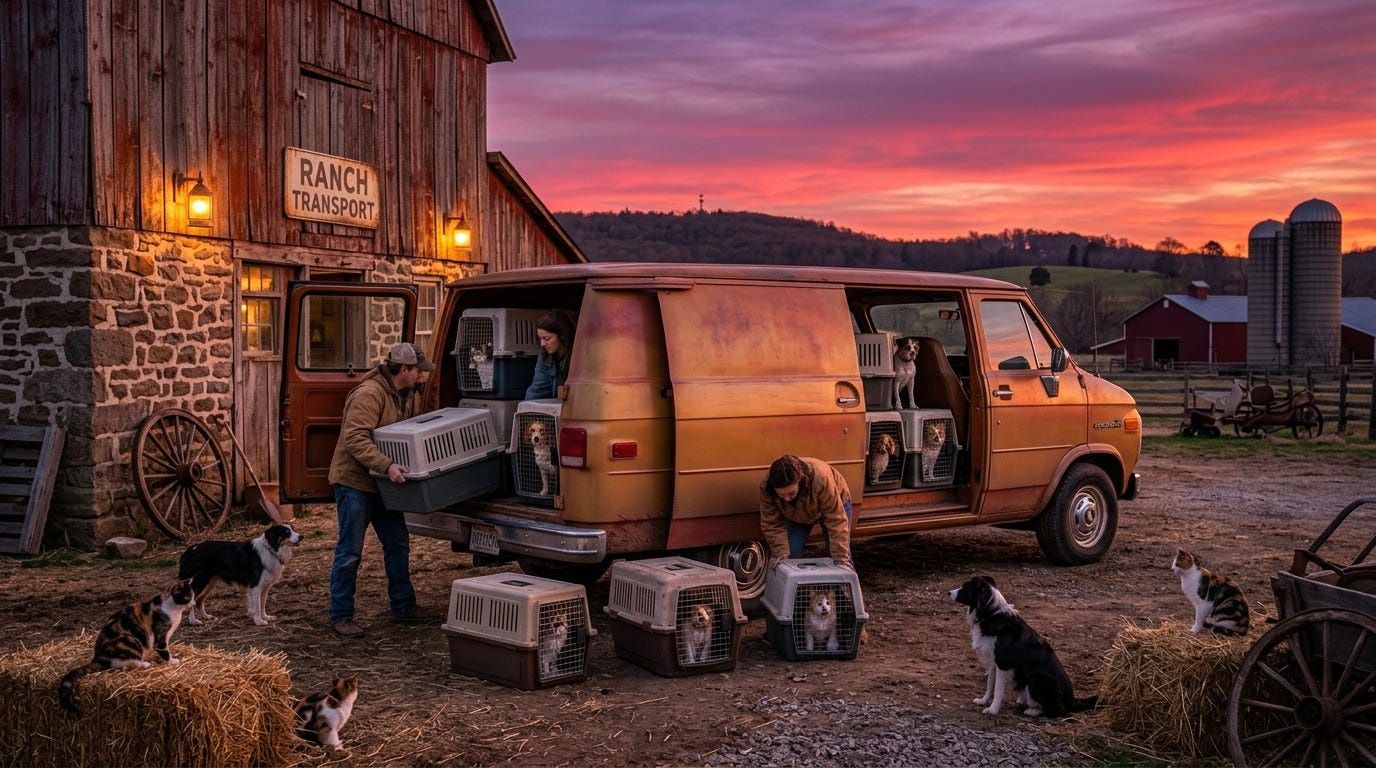
The van is loaded. Forty dogs, a health certificate clipped to every crate, a fourteen-hour run north in front of you. You have done this so many times you could back the trailer to the dock in your sleep. It feels like a win, because it is one. Forty animals that were about to run out of time here are going to walk into open kennels in a state that ran out of dogs to adopt years ago. You will get the photos back. Tails, new couches, kids on the floor. That is real, and you earned it.
Then you come in Monday and the kennels you emptied on Friday are full again.
Somewhere in the last twenty years, animal welfare quietly decided that transport is prevention. We put it in the lifesaving column. We measure it, we fund it, we celebrate it, and we are right to, because it keeps alive animals who would not otherwise make it. But keeping an animal alive and preventing the next one are not the same act, and we have started to treat them like they are.
Transport is not prevention. Transport is geography. It changes the animal’s zip code. It does not change the reason the animal entered the system.
Kay Stout ran this experiment in real life without meaning to. She took over a rescue in rural Oklahoma and built a transport program good enough to move forty dogs a week to Colorado. Forty a week is a serious operation. And in six weeks she had fifty full kennels with a waiting list of a hundred and fifty owner surrenders stacked up behind them. The transport was working perfectly. The intake never slowed down, because nothing the trucks did touched the reason the dogs were coming in. What finally moved the math in her county was not the trucks. It was the day the front end got funded, a spay/neuter program that is still running, quietly draining the supply the trucks used to haul.
Run it up to the national level and it gets clearer, not fuzzier. Shelter Animals Count put 2025 intake at 5.8 million. Transport, by definition, cannot lower that number. A dog moved from Alabama to Vermont is still one dog in the national count. Transport is a redistribution, not a reduction. It takes animals from places that make too many and hands them to places that make too few, and for about two decades that worked, because the receiving regions had room. They are running out of room. The empty shelters up north that absorbed southern dogs for a generation are not empty anymore. They are taking in parvo, heartworm, and behavior cases they were not built for, and they are starting to say no. When the receiving end fills up, a strategy built on geography has nowhere left to put the problem.
The research says it out loud. The rural sheltering study out of Oklahoma found that a lot of the places we call no-kill got there by limiting intake or shipping animals out of state, not by reducing the number of animals in trouble. On paper the save rate looks like prevention. On the ground it is a conveyor belt with a nicer dashboard.
None of this is an argument against transport, and if you coordinate transport, do not hear it as one. Transport is triage. It is the ambulance. When an animal is already in the system and already out of time, the run north is the most humane thing on the table, and the people who drive those routes at 4 a.m. are saving lives the front end failed to protect in time. Keep driving.
But an ambulance is not a health plan. If the only thing your county funds is the ambulance, you have decided to treat a preventable problem one emergency at a time, forever, and to pay the highest possible price for it. Transport buys you this month. Only the front end buys you the future.
The front end has a dose. Spay and neuter at a rate of three to four surgeries per 1,000 residents a year and the population keeps growing, you never catch up. At five to six, it holds steady. Get to seven or eight and hold it for five years, and shelter intake falls by roughly half. That is a practitioner model, field-tested in Huntsville, where a spay/neuter program that grew from twenty thousand dollars a year to a hundred thousand watched citywide intake fall from about ten thousand animals to about five thousand, even as the city grew. No trucks required. The dogs that program prevented were never born to need a ride.
Know somebody running an animal control budget, a foundation grant cycle, or a shelter intake desk? Send this. They are the ones who decide whether the next five years look like the last five.
Here is the part you can screenshot. If you run transport and you want to know whether it is buying you time or hiding a prevention problem, watch these four numbers.
The four numbers that tell you whether transport is masking an intake problem
1. Refill rate. How fast do the kennels you empty fill back up? If a Friday transport is undone by Monday, you are treading water, not gaining ground.
2. Owner-surrender waitlist. Is the list of families waiting to surrender growing while you transport? If it is, you are moving animals to make room for the next wave, not shrinking the wave.
3. Spay/neuter dose. How many surgeries per 1,000 residents a year is your catchment actually getting? Under five and you are not touching the source, no matter how many trucks you run.
4. Year-over-year intake. Not save rate. Intake. If the number of animals entering the system is flat or climbing while your transport numbers rise, transport is carrying the whole strategy, and that is a strategy with a ceiling.
If those four are moving the right way, transport is doing exactly what it should, buying room while prevention catches up. If they are not, transport is the only thing between you and a flood, and no amount of driving fixes a flood.
We are not going to transport our way out of this. We never were. The trucks were always meant to be the bridge, not the destination. The counties and coalitions that make it through the next five years will be the ones that kept the ambulances running and finally started funding the seatbelts.
Join the shift to prevention.
Donate to Prevention and fund what happens before the shelter.
Animal-Angels Foundation
angels@animal-angels.org
animal-angelsfoundation.org
Connect with us:
LinkedIn: linkedin.com/company/animalangels
Facebook: facebook.com/animalangelsfoun
Instagram: instagram.com/an.gels377
Animal-Angels Foundation Inc
A 501(c)(3) public charity
Tax ID 41-3166394
We welcome DAF and QCD gifts.
Serving Jefferson, Shelby, Blount, St. Clair, Walker, Bibb, and Chilton counties in Central Alabama.
Pet Help Desk: (205) 754-7542
Email: angels@animal-angels.org
Mail: 4906 Vise Road, Pinson, AL 35126
Web: animal-angelsfoundation.org
Donate: animal-angelsfoundation.org/Donate.html
By Animal-Angels Foundation, a prevention-first 501(c)(3).