


You know the call
A family reaches you needing something you do not do. You are pretty sure somebody across town does it, but you do not have their number, their hours, or a clean way to hand the family over. So you burn an afternoon chasing it down, or you say the words you hate saying, sorry, we do not do that, and the line goes quiet. A week later that pet is in a shelter. Everybody in this field has been on the wrong end of that call. Not because anyone stopped caring. Because nobody built the thing that connects us.
That is what the Animal Welfare Resource Network (AWRN) is.
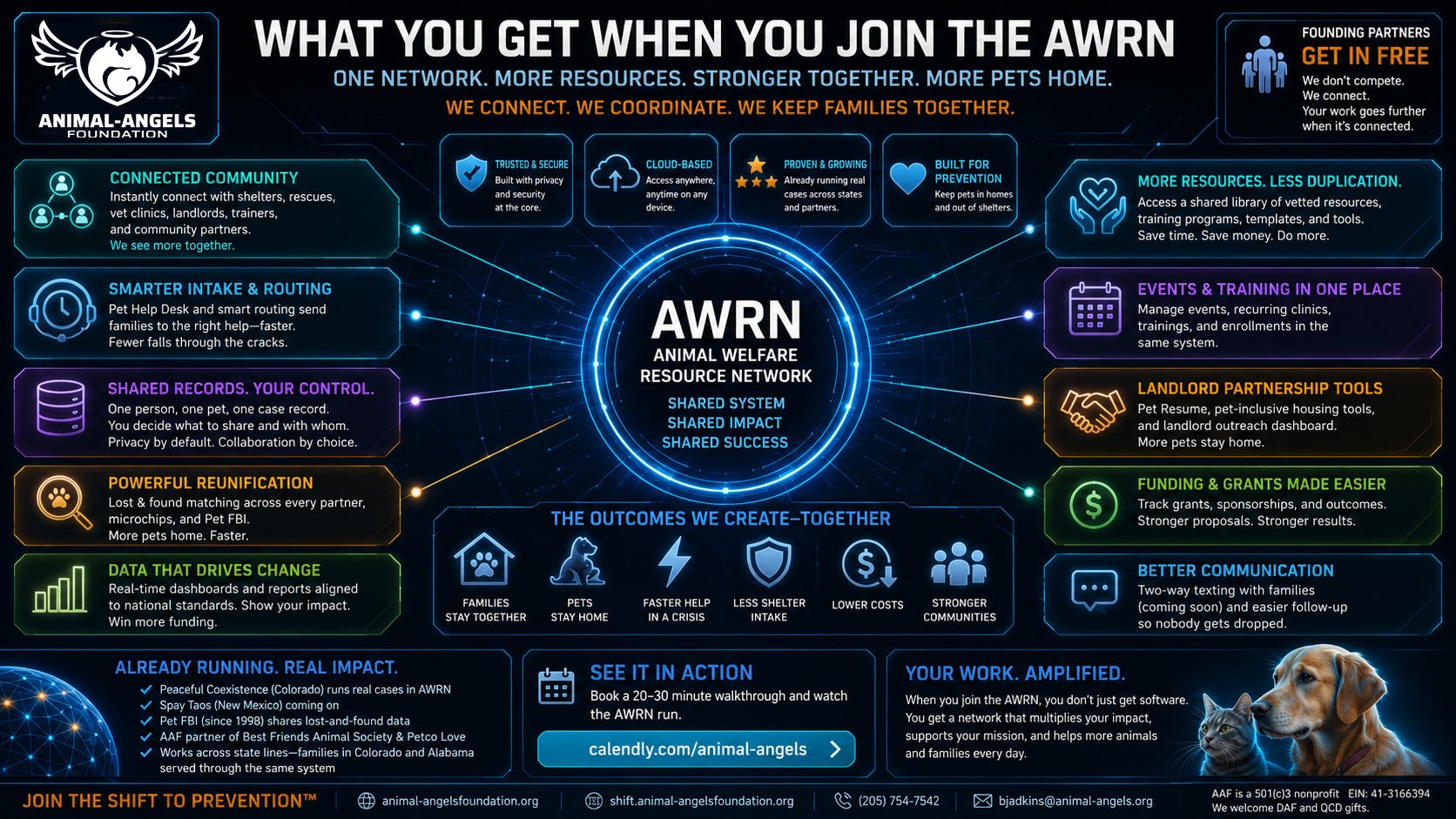
What the AWRN is
Animal-Angels Foundation built the AWRN as shared infrastructure. One system that connects shelters, rescues, veterinary clinics, landlords, trainers, community organizations, fosters, and volunteers. Think of it the way you think of a cell network. Everyone gets on the same system, and that is what makes them faster and more connected. It is not one organization at the center with everyone else feeding into it. Every partner connects to every other partner. AAF builds and runs the shared infrastructure, and it does not sit at the center.
What you get when you join
Here is what changes the day you join. You stop being the front door for every problem in the region and start getting only the requests that match what you actually do, already triaged, the need written down before the family reaches you. When someone needs something outside your lane, you hand them off inside the same system instead of leaving them stranded. Your records stay private until you choose to share them. Every family you send and every one sent to you gets followed up on, so nobody falls through. And you finally see the real call demand in your area, the number your funders keep asking for that you never had a way to count. Do the work well and the network sends you more, because routing favors partners with a track record. Reliability earns referrals here. Nobody buys their way to the front.
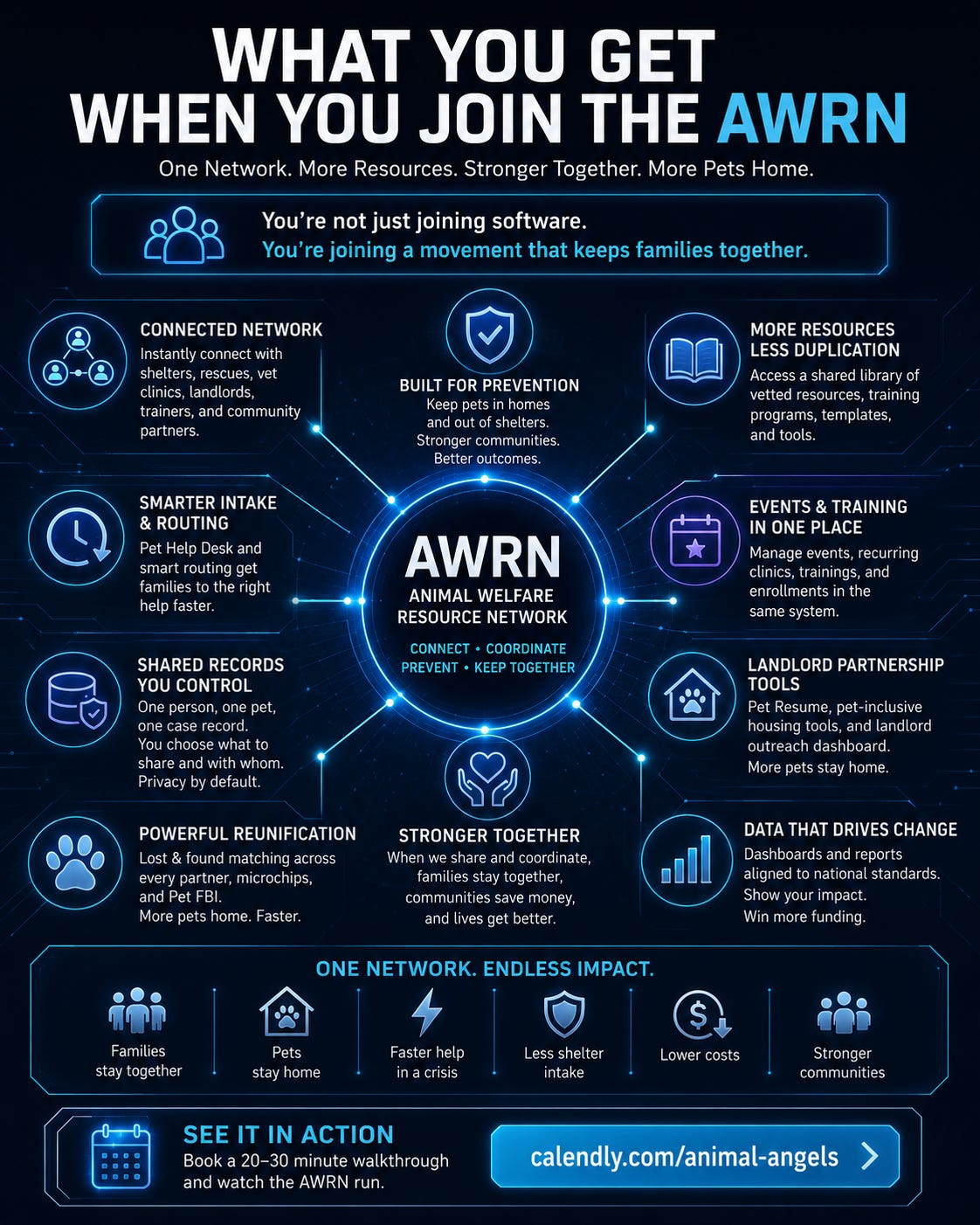
It costs contributing partners nothing
Contributing partners join free. The organizations who help build this while it is young, the founding partners, stay free for life, even as the network grows. You are not paying to get in. You are getting in early.
This is already running
The AWRN is not a concept. Peaceful Coexistence, a prevention nonprofit in Colorado, is running real cases in the network today. Spay Taos in New Mexico is coming on. Pet FBI, a lost-and-found database operating since 1998, is sharing data with the network so more pets get home. AAF is a partner of Best Friends Animal Society and Petco Love. And the network already works across state lines. A family in Colorado called for help and was served through the same system a family in Alabama uses. That is exactly what a network is supposed to do.
Why it works when nothing else has
Most animal welfare software manages one organization’s work. The AWRN coordinates across many. When a family shows up at a clinic that cannot help them, the clinic sends them, inside the same system, to a partner who can. When a shelter takes in a stray, the network checks it against every lost-pet report across all partners, not just its own. That shared layer is the difference between a stack of separate tools and a real network. The field already wrote the playbook for what organizations should do together. Nobody built the system to actually run it together. That system is the AWRN.
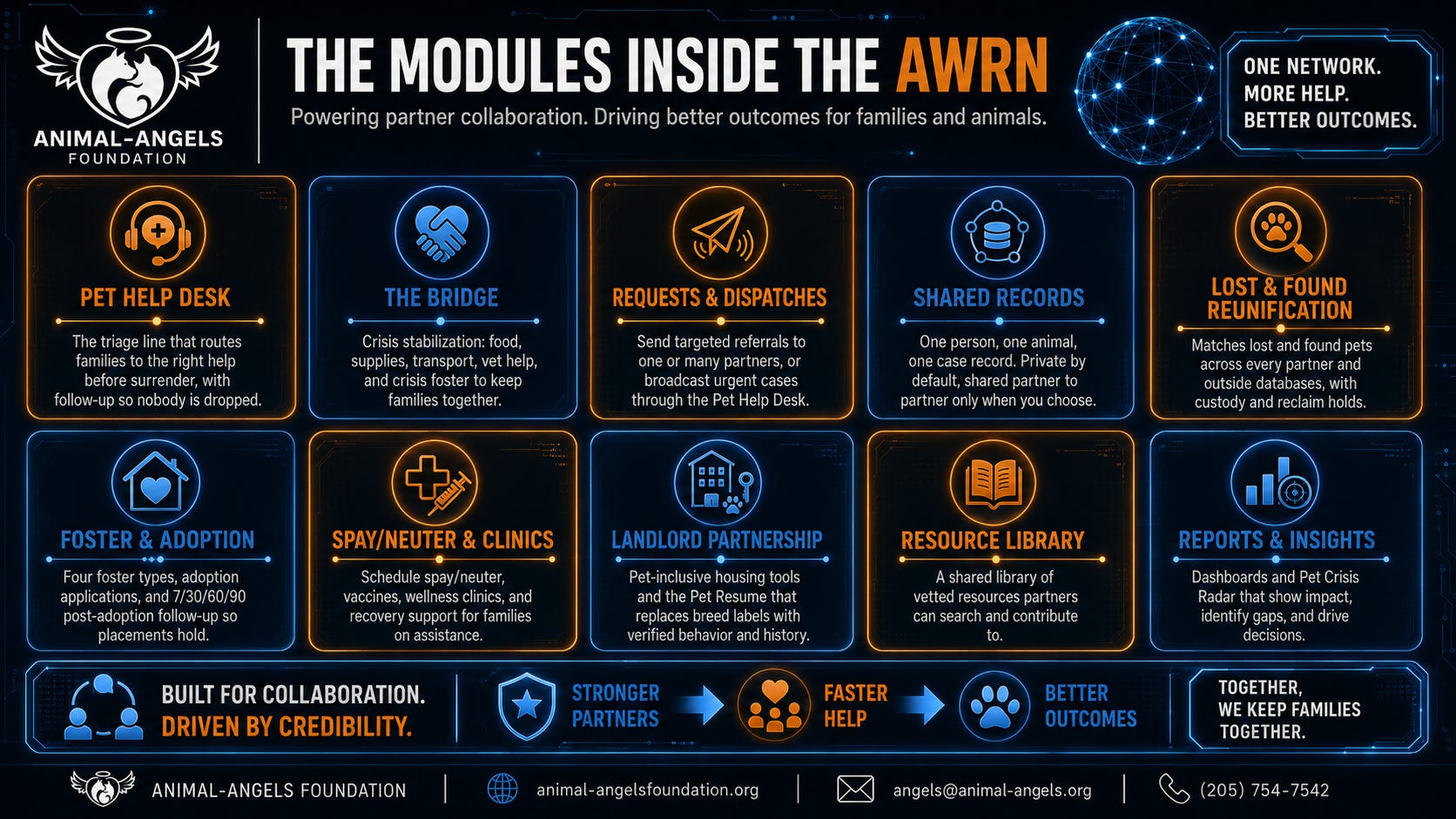
What the network does, module by module
Once you are in, here is what you are working with.
Pet Help Desk: a nationwide triage line and intake that routes a family to the right help before surrender, with follow-up tracking so nobody gets dropped. Toll free number (833) 754-7542.
Front Desk: each partner can track its own incoming calls and route them to the right program or partners.
The Bridge: crisis stabilization. Logs food, supplies, transport, emergency vet help, and crisis foster placements, plus housing and landlord support, managed rehoming, community cat work, and wellness clinics.
Shared animal and people records: one person record, one animal record, one case record. Records stay private by default. A partner turns on sharing when they want another partner to see a specific record, so you control who sees what while everyone works from the same underlying record.
Requests: send a targeted referral to one partner or several that provide the services a pet owner needs in your service area, and expand to other areas or your whole state if needed. Urgent requests go to the Pet Help Desk, which routes them to the partners in the relevant area that accept urgent requests. Routing favors partners with a strong track record.
Lost and found reunification: matches lost and found pets across every partner and outside databases, including microchip lookup and Pet FBI, with custody transfer and reclaim holds built in.
Foster and adoption management: tracks adoption applications and four foster types, Foster-to-Train, Finder-to-Foster, Temporary Crisis foster, and Regular Foster, plus a 7/30/60/90 post-adoption follow-up so placements hold.
Spay/neuter and clinics: schedules spay/neuter and vaccine services, wellness clinics, and recovery support for families on assistance.
Landlord partnership: pet-inclusive housing tools, the Pet Resume that replaces breed labels with verified behavior and rental history, and a landlord outreach dashboard.
Resource library: a shared library of vetted resources partners can search and contribute to.
Community events calendar: public events partners can add to and embed on their own website.
Event Coordinator: plan and track events start to finish, and create recurring events from templates.
Training management: manage training programs and enrollments inside the same system.
Grant and sponsorship tracker: a private funding pipeline each organization manages for itself that let’s you track your grants and sponsorships - no more excel files.
Intelligence and reporting: dashboards that report to funders and to national standards. The Pet Crisis Radar heat map lives in the network Intelligence Center, administered by Animal-Angels Foundation.
Coming next
A pet-to-adopter matcher for adoptions, developed with a university adoption-decision researcher and grounded in peer-reviewed research.
An AI-assisted resource librarian.
AI translation of veterinary records into plain language.
Two-way texting with families.
Who it is for
The AWRN is for any organization tired of working in a silo. Founding partners get in free. We do not compete. We connect, and your work goes further when it is connected to everyone else’s. Shelters are still needed for the animals who truly need a safe space. The Animal Welfare Resource Network is how the rest of us keep those animals from ever needing one.
Book a 20 to 30 minute walkthrough and watch it run.
Schedule at calendly.com/animal-angels.
Join the shift to prevention.
Donate to Prevention and fund what happens before the shelter.
Animal-Angels Foundation
angels@animal-angels.org
animal-angelsfoundation.org
Connect with us:
LinkedIn: linkedin.com/company/animalangels
Facebook: facebook.com/animalangelsfoun
Instagram: instagram.com/an.gels377
Animal-Angels Foundation Inc
A 501(c)(3) public charity
Tax ID 41-3166394
We welcome DAF and QCD gifts.
Serving Jefferson, Shelby, Blount, St. Clair, Walker, Bibb, and Chilton counties in Central Alabama.
Pet Help Desk: (205) 754-7542
Email: angels@animal-angels.org
Mail: 4906 Vise Road, Pinson, AL 35126
Web: animal-angelsfoundation.org
Donate: animal-angelsfoundation.org/Donate.html
By Animal-Angels Foundation, a prevention-first 501(c)(3).