


Last week the city of Sylacauga, Alabama, tabled a proposal to manage a pack of stray dogs on the US-280 corridor by sedating them or, in option three, shooting them with a .22 rifle. The public revolted. The mayor publicly opposed the lethal option. The council postponed the vote to May 21 and is now looking at alternatives.
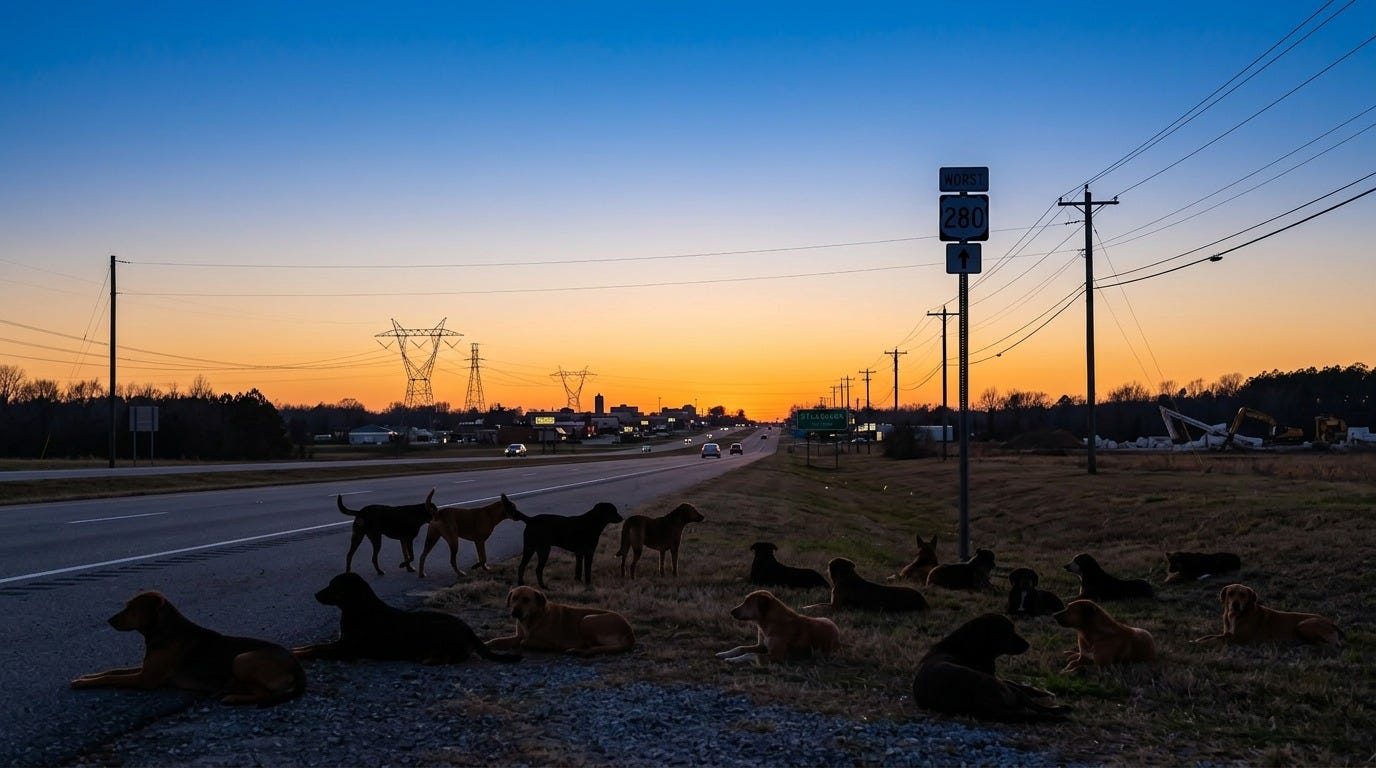
Here is what almost nobody covering this story is saying out loud.
Even if Sylacauga clears the US-280 pack tomorrow, six to eight months later there will be another pack. The .22 would not have fixed anything. The sedation contract would not have fixed anything. The trapping option would not have fixed anything. None of the three options changes a single thing about why those dogs were there in the first place.
That is the treadmill.
The treadmill
Stray populations are not a one-time problem you solve with a one-time intervention. They are an output of conditions: unaltered free-roaming dogs, an absence of community-accessible spay and neuter, owned dogs being dumped because their families ran out of housing or money or time, and a public who feeds the dogs out of love because no one has given them anywhere else to send their care.
Pick up every dog on US-280 today. The conditions are still there. Six months from now, the same conditions produce a new pack. Maybe in a different location. Maybe a different size. The math says it happens.
This is not theoretical. We have decades of data on this from rescue networks across the country. Kay Stout in Oklahoma built a transport program that moved forty dogs per week from her rural shelter to Colorado. That program was operationally successful. It was also a treadmill, because nothing in the source community changed. The dogs kept coming because the conditions producing them kept producing them. Stout and the researchers she works with at the University of Oklahoma named this pattern in their February 2026 paper on shelter deserts. Removal without prevention does not reduce the long-term population. It just changes which counties write the checks.
Sylacauga is about to write the check. The question is whether the check buys a treadmill or buys an exit.
What an exit looks like
The exit is a four-part prevention model that any small city can run with the right partners. None of it is novel. All of it is documented. Most cities do not run it because nobody has put it in front of them in one piece. Here it is.
Part one. Targeted catch-spay-vaccinate-microchip operations for the established stray population. Not trap-and-relocate. Not trap-and-kill. Catch, sterilize, vaccinate, microchip, and return the dogs to their community range if they are settled, or place them in a foster network if they show enough socialization to be adopted. The first time you do this, you stop the breeding cycle in that specific population. The second time you do this, you discover most of the dogs you are catching are dogs you already caught, which means the population is stabilizing.
Part two. Intake diversion. Most “stray” packs are not feral. They are owned dogs who got dumped. A working Pet Help Desk, a Bridge program that helps families through the crisis that would otherwise end with the dog on the side of US-280, and a community-known number to call before you abandon a pet means fewer dogs get dumped in the first place. Prevention upstream of the pack.
Part three. Community feeder conversion. Sylacauga’s animal shelter manager publicly named the trap failure pattern this week: people in the community are feeding the dogs constantly. Bait does not work because the dogs are not hungry. Most cities respond with “stop feeding the strays” campaigns that fail because the feeders genuinely care about the dogs. The conversion play is to find the feeders, partner with them, move the feeding to your trap location, and tell them honestly what will happen to the dogs (spay, vaccinate, microchip, return or place). Feeders almost always agree once they know the dogs are not going to be killed. You convert a sabotage problem into a force multiplier.
Part four. A regional partner network. No single small Alabama city has the veterinary capacity, the foster homes, the transport, the supply chain, or the adoption pipeline to handle a full prevention operation on its own. Sylacauga is twenty minutes from Shelby County. Forty minutes from Birmingham. The veterinary clinics, rescues, and humane societies already exist in the region. They just are not coordinated. A regional network lets Sylacauga draw on the existing infrastructure of the surrounding counties for the work that Sylacauga cannot do alone. This is the work Animal-Angels Foundation does in its seven-county service area west of Talladega. It is what the Animal Welfare Resource Network was built for.
The budget question
Sylacauga is considering allocating up to twenty-five thousand dollars to bring in an outside contractor whose menu of options included shooting dogs with a .22.
Twenty-five thousand dollars would fund a real prevention pilot. The same dollars, redirected, pay for spay and neuter capacity through a regional vet network, microchips, trapping supplies, transport, a part-time community liaison to do feeder conversion, and a coordination contract with a regional partner. The math is not even close. The contractor option spends the money once and produces another pack in six months. The prevention pilot spends the money once and produces a downward trajectory that takes the city out of the cycle.
Mayor Hubbard already started a city spay and neuter clinic for residents’ pets. That puts Sylacauga halfway to the exit before any vote on May 21. The other half is partnering on the operational work that the city’s one animal control officer cannot do alone.
What to do with this
If you are a city official in any small Alabama town, call your nearest prevention-focused animal welfare nonprofit before the next pack shows up. The window to do this proactively is so much cheaper than the window to do it reactively.
If you work in animal welfare and you see this pattern in your community, name it. Not the lethal proposal. The treadmill. People will argue forever about whether to shoot the dogs. Almost no one is having the right argument, which is what happens after.
If you live in a city that has not had its Sylacauga moment yet, ask your city council a single question this month. What prevention infrastructure does this city have to keep stray populations from forming. If the answer is “we deal with it when it happens,” you have time to do something before you are reading your own city’s name in this newsletter.
Prevention is the missing piece. Sylacauga is one tabled vote and one council meeting away from being one of the few small Alabama cities that figured it out before everyone else do.
We keep families together. We keep dogs out of the cycle. We do not compete. We connect.
BJ Adkins Founder, Animal-Angels Foundation Recognized in Marquis Who’s Who in America (April 2026) theshifttoprevention.substack.com
P.S. I have offered Mayor Hubbard and the Sylacauga Animal Shelter Manager a no-cost consultation before the May 21 vote. If you are in another small Alabama city watching this story and you do not want your council to be the next one debating a .22 rifle, the same offer is on the table for you. animal-angelsfoundation.org.