


A woman called me frantic and crying. She was afraid she was going to lose her dog.
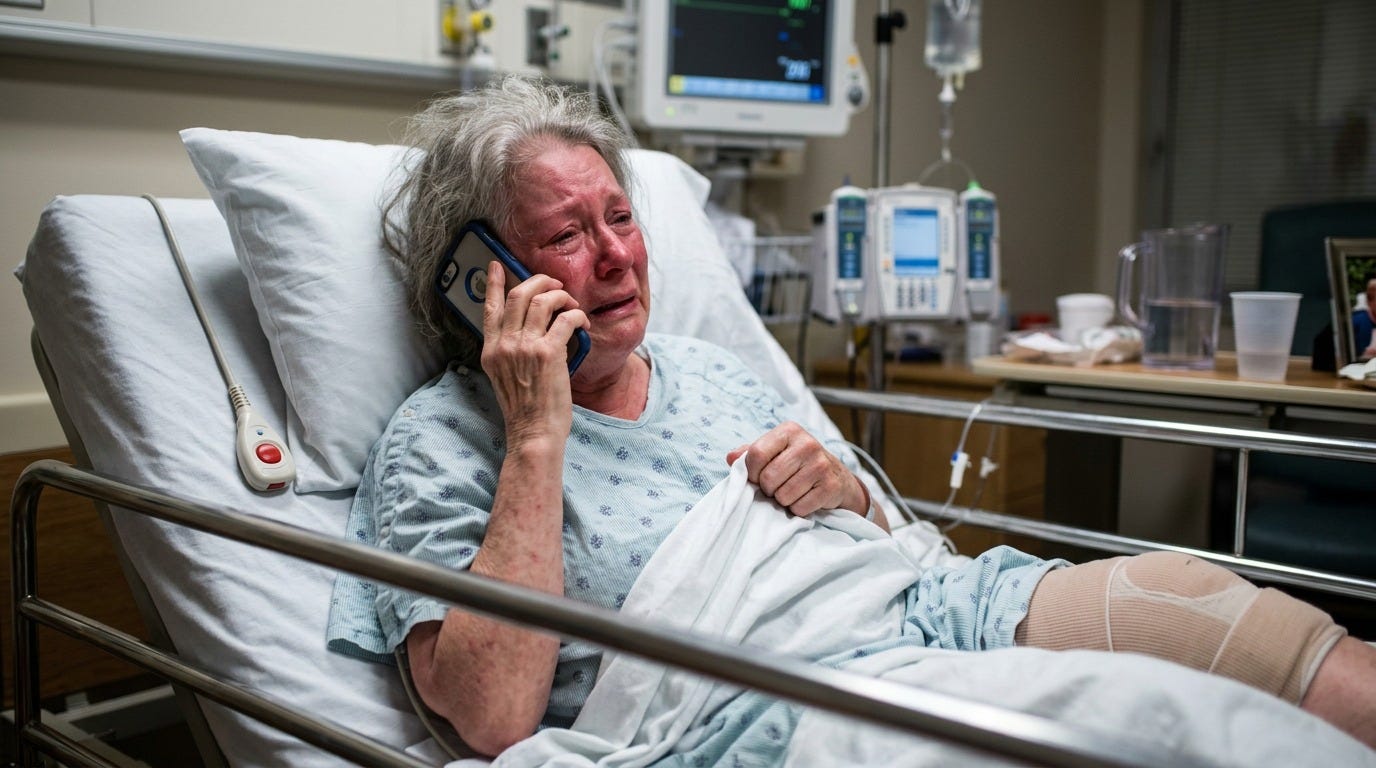
Her name is Lisa. She lives in Trussville. She had broken her hip and was in the hospital recovering from surgery, which is its own story for any human being to live through. The dog’s name is Buddy. He had been at home this whole time, looked after by a neighbor who was going over three times a day to feed him and take him out.
The neighbor had finally said he could not keep doing it. He had his own life and it had caught up with him.
Lisa’s sister had then stepped in with the kind of help nobody asks for. She told Lisa she was going to find Buddy a new home. Buddy was going to get rid of, was the phrasing. Lisa heard it from a hospital bed two days out of hip surgery with no way to drive home and stop it.
That was the call we got. That was the moment Animal-Angels Foundation existed for.
Eleven Days of Texts Before the Call
Lisa had first reached out to AAF nearly two weeks earlier, looking for foster help. We had been in touch with her every day since. Eleven days of follow-up texts checking in on her, on the neighbor situation, on the hospital recovery timeline, on Buddy. None of it had felt like a crisis on either end. It was a family handling a medical event with a workable plan.
Then the neighbor pulled out. Then the sister started talking about rehoming the dog. Then Lisa, two days post-surgery, was on the phone with us at the point of losing her best friend while she was still hooked up to recovery monitors.
We had Buddy out of the house within 24 hours.
The Crisis Foster Chain
AAF runs a sub-program of the Bridge called Crisis Foster. It exists for exactly this scenario. A pet owner is hospitalized, evicted, dealing with a medical emergency, or facing a situation that makes it impossible to care for the animal for a defined window. The pet does not need a permanent new home. The pet needs a safe, temporary, vetted foster placement while the owner gets stable.
Crisis Foster is built around the certainty that the owner is coming back for the animal. It is not surrender. It is not rehoming. It is the gap-filling support that lets the family stay a family while the owner deals with the thing that needs dealing with.
Buddy went to a crisis foster named Danny, an experienced AAF foster with a big fenced yard, two of his own dogs, and a track record of taking on placements like this. Danny met Buddy on the day of pickup. Buddy went home with him that night. From hospital-bed crisis call to safe, vetted foster placement: less than 24 hours.
Buddy stays with Danny through the early part of Lisa’s recovery. As her timeline clarifies, AAF transitions Buddy to a longer-term temporary foster who can hold him for the remainder of her recovery window. When Lisa is home and physically able to take Buddy back, we return him. That is the whole arc. That is the entire program.
The Paperwork That Protected Her
The other thing that happened on the pickup day was a signed authorization between Lisa and AAF. Section A, clause 4 of that document is the line that protects against exactly what the sister was trying to do. Once Buddy is in AAF custody as a Crisis Foster placement, no third party (including a sibling, a roommate, or anyone else with access to the home) can rehome the animal or transfer custody to anyone else. AAF holds the placement. Lisa holds the ownership. The sister no longer has a say.
That clause is not standard rescue paperwork. We wrote it after seeing this exact pattern repeat itself. A pet owner in a medical crisis loses agency over a decision that should be theirs, because a family member with good intentions or bad intentions makes a unilateral call. Crisis Foster solves that by formally moving the pet out of the situation while preserving the owner’s rights.
Lisa signed it from her hospital bed. Buddy left her house that afternoon. Her sister did not get to make the decision.
The Part Most People Miss
If AAF had not existed, here is what was going to happen to Buddy. Lisa’s sister, acting with what she believed was reasonable judgment, would have rehomed Buddy to someone she knew or listed him on a free-pet site. Lisa would have come home from the hospital and the dog would have been gone. Best-case scenario: Buddy ends up somewhere fine and Lisa never sees him again. Worst-case scenario: Buddy ends up somewhere not fine and Lisa carries the guilt of that for the rest of her life.
Either outcome is a surrender that Lisa did not choose. The official data would not even call it a surrender, because Lisa never signed paperwork giving up her dog. The dog would have just been gone.
This pattern happens more often than the field admits. Pet owners in medical crises lose pets because they are not in the position to defend them. Adult children, siblings, well-meaning neighbors, landlords, hospital staff, ex-partners. All of them have stepped in at various points to make a decision the owner did not get to make. The Bridge program exists in part to interrupt that pattern.
What This Costs
Every Crisis Foster placement has real costs. AAF covers food and supplies for the foster home so the foster is not subsidizing the work out of pocket. AAF covers any vet care the animal needs during the placement. AAF covers transport between placements if the foster chain needs to extend. AAF covers the staff time to coordinate the placement, run check-ins on the foster, and manage the return-to-owner logistics.
A typical Crisis Foster placement runs $150 to $400 across the full window depending on length and medical needs. Buddy’s placement is on the lower end of that range. The total cost to AAF for keeping Lisa and Buddy together while she recovered from hip surgery is less than what most families spend on a single weekend trip.
Lisa’s case is one of dozens AAF has handled since we became operational. Every one of them has the same shape. A family in temporary crisis. A pet who needs a safe place while the owner gets stable. A return-to-owner outcome that almost never happens without the infrastructure in place to support it.
If You Want to Fund the Next One
The Bridge runs on donations. Crisis Foster runs on donations. Every dollar that goes into the Bridge Fund is a dollar waiting for the next hospital-bed phone call from a family that does not know yet who is going to call them about their dog while they are trying to recover.
Three hundred dollars covers one full Crisis Foster placement for a family in Lisa’s situation. One hundred dollars covers food and supplies for a Bridge case like the one we handled this month for a mother in St. Clair County. Fifty dollars buys a week of supplies for a foster home holding a pet whose owner is still in the hospital.
If you want to be part of the infrastructure that picks up the next frantic crying call, the donation page is at animal-angelsfoundation.org/BridgeFund.html. Every dollar that lands there sits in the fund until the next call. Every dollar that lands there is a family who gets to stay a family.
Buddy has a home to go back to. Lisa has a dog to recover for. That outcome was not free, and it was not automatic. Somebody paid for it. The next family in this same spot is going to need somebody to pay for theirs too.
Every dollar funds the next emergency response. Direct, immediate, no overhead skimming.
This is what prevention looks like.