


3 weeks ago, a city council in central Alabama spent ninety minutes debating whether to allocate twenty-five thousand dollars to shoot a pack of stray dogs with .22 rifles.
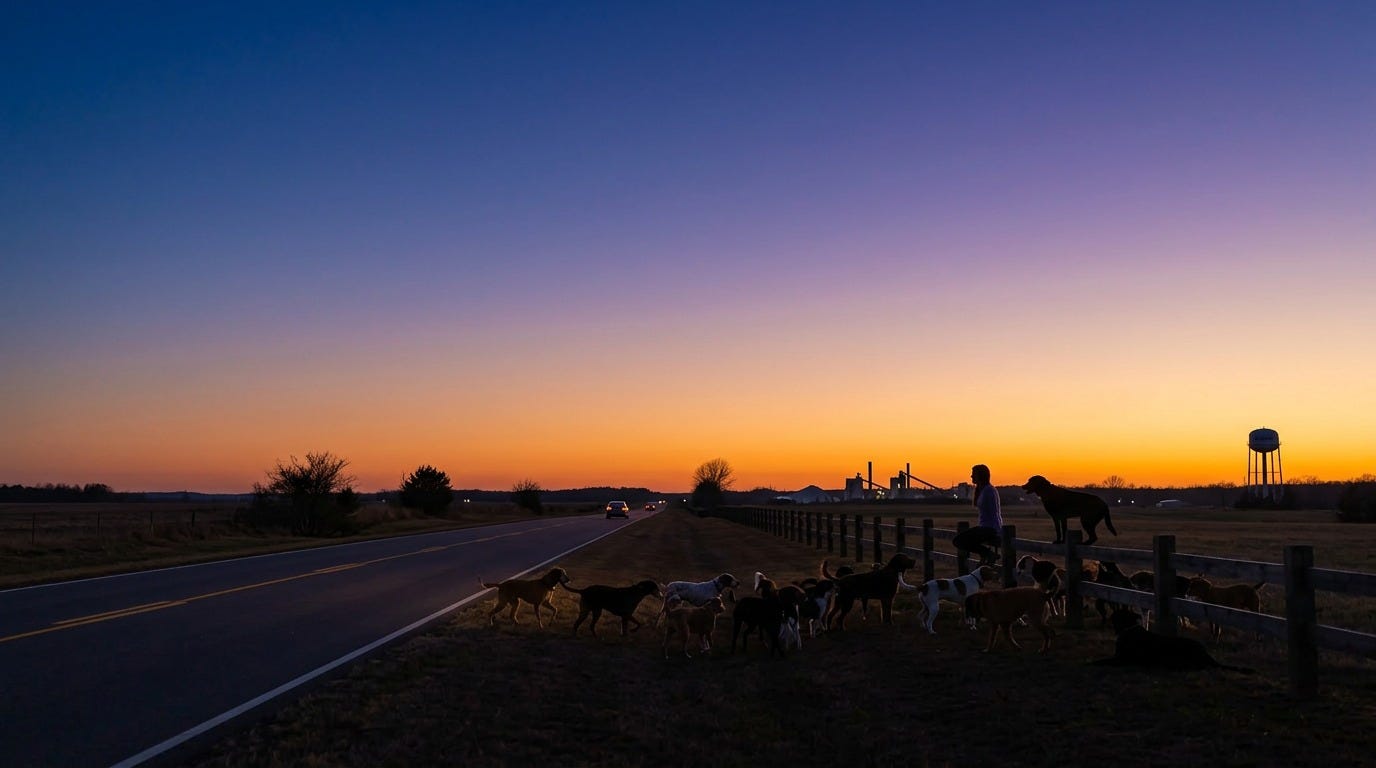
The mayor proposed it. The police chief proposed it. A landscaping company quoted the work. Some council members opposed. Some supported. Citizens packed the meeting room, the Facebook comments, and the local news call-in lines.
Read every word of the coverage. Every public statement. Every council member quote. Every concerned citizen calling the mayor’s office.
Almost nobody mentioned prevention.
“Do not shoot the dogs” was the unanimous refrain from opponents. Not “do this instead.” A piece of legal analysis ran to 3,000 words on county confinement law adoption and pound impoundment compliance, with one sentence on spay and neuter. The animal shelter director publicly blamed community members feeding the dogs. The police chief floated foothold traps, sedation, and the .22 as if those were the only three options on the menu.
That whole chain of voices is the article. Because almost nobody in it could see prevention. They could see the dogs. They could see the proposal. They could see what they did not want. Almost nobody could see the root causes that produced the dogs in the first place, or articulate what would change those conditions instead of just changing the outcome.
This is the gap. This is what almost every animal welfare conversation runs into when it actually matters.
The root causes are invisible
Most people, when they look at a stray dog pack, see the stray dog pack. They do not see:
Unaltered free-roaming dogs in the surrounding county because the county never adopted dog confinement laws.
Owned dogs being abandoned because families ran out of money, housing, transportation, or options.
A regional spay and neuter access gap that means low-income families have nowhere to take their dog.
A community feeding pattern that defeats trapping efforts because well-meaning neighbors keep the dogs fed.
A neighboring county with no animal control infrastructure pushing its dogs into the next city over.
A historical lack of accessible veterinary care for the same low-income families now blamed for the loose dogs.
All of those are root causes. All of them are addressable. None of them are visible in a Facebook outrage thread or a council meeting agenda or a legal analysis. They have to be named explicitly, repeatedly, by people who can see them. That naming is prevention work.
Why the reactive frame is the default
The reactive frame is the default because reactive feels concrete. There is a pack of dogs. They are visible. They are a problem. We propose a solution to the problem.
Prevention, by contrast, feels abstract. Conditions are diffuse. Causation is plural. The fix is “address the conditions over twenty-four months” instead of “remove the dogs by Friday.” One of those is news. The other is policy work.
This is why even allies of prevention default to reactive framing when they document a situation in real time. Legal analysis is concrete: cite the statute, name the violation, document the procedural failure. Reactive solutions are concrete: trap, transport, contractor, allocation. Prevention thinking is abstract until you see it run. It is also the only thing that actually changes the outcome long term.
This is a coalition argument. Hand it to one person in your network who has not seen the math. That is how the shift starts.
What prevention thinking actually looks like
Prevention thinking asks one question before any other: what conditions produced this, and what changes the conditions?
Not “what do we do about the dogs on Highway 280.” But “why are there dogs on Highway 280, and what makes that not be the case six months from now?”
When the answer is “the county next door has no animal control and dogs are migrating across the line,” prevention thinking pushes county-level confinement law adoption.
When the answer is “low-income families have no access to spay and neuter,” prevention thinking pushes door-to-door clinics, high-impact pop-up clinics, and a free or low-cost spay and neuter program with real outreach behind it.
When the answer is “families dump their dogs when they hit a crisis,” prevention thinking pushes a Pet Help Desk and a Bridge program that catches families before the dump.
When the answer is “the community is feeding the dogs and defeating the traps,” prevention thinking pushes community feeder conversion, not stop-feeding signage.
Notice what these all have in common. They change the conditions. The next year, the next decade, the next council meeting, the conditions are different. The pack does not reform. The contractor does not get hired. The Mayor’s office does not field outraged phone calls again.
That is what prevention buys.
The 121,000 intake reduction
The Shelter Animals Count 2025 Annual Data Report, published by the ASPCA, reports that dog and cat community intakes dropped by 121,000 nationwide compared to 2024. A 2 percent decrease. Real win. Real numbers. 5.8 million animals entering shelters in 2025 instead of 5.9 million in 2024.
It could have been ten times that.
The framing inside the report is reactive. “Community intakes slightly decreased.” The metric measures fewer animals entering shelters. The underlying work was real: more rescues absorbing transfers, faster adoption pathways, shorter length of stay. Good work. Necessary work. Not enough work.
Look at the same report and find the population balance number. In 2025, 147,000 more pets entered the sheltered system than left it. The shelter year-end population grew, even though intake decreased. The intake-reduction win was a real win on its own metric. But the system as a whole is still adding animals faster than it can place them.
If the root causes had been addressed at the same scale as the intake-reduction work (county-level dog confinement law gaps, regional spay and neuter access deserts, owner support during crisis, community education on responsible pet ownership, high-impact clinic access for low-income families), the numbers would be categorically different. Not 121,000 fewer intakes. Closer to 1.2 million fewer animals needing the infrastructure in the first place. And the gap, the 147,000 pets stuck in the system at year’s end, would be moving in the right direction instead of the wrong one.
Reactive framing celebrates the catch. Prevention framing measures the prevented entry. The two are not the same metric. The two will never produce the same scale of outcome. Notice the language in the report: “slightly decreased.” Even the field’s most trusted national dataset uses the reactive frame as its default. That is how deep the default goes.
Send this to one person who has not connected these dots yet. The math only matters when more people are running it.
Know somebody running an animal control budget, a foundation grant cycle, or a shelter intake desk? Send this. They are the ones who decide whether the next five years look like the last five.
This is the article I will keep writing
The hardest thing about prevention work is not the operational complexity. It is that the prevention conversation has to keep being reopened. Every news cycle. Every council vote. Every viral Facebook post about a pack of stray dogs. Every time someone calls their mayor to say “do not shoot the dogs” without saying what to do instead.
Most people forget the prevention frame within a week of hearing it. They go back to outrage, legal-regulatory, or reactive operations as their default lenses. Because those lenses are easier, more visible, and feel more concrete in the moment.
So I will write this article again. Different city next time. Different species maybe. Different specific failure pattern. Same underlying gap. The public competency that needs to be built (prevention thinking) is not built by one piece. It is built by a continual re-education effort that meets each new news cycle with the same patient framing.
What to do with this
If you are a citizen calling your mayor’s office: do not just say “do not shoot the dogs.” Say “fund a prevention pilot instead.” Be specific. Have three programs named.
If you are an elected official: the next time animal services brings you a proposal, ask “what would prevent this from being a recurring problem in two years?” If they cannot answer, send them back.
If you write or document or report on animal welfare: prevention sits in the same paragraph as the legal framework. Not as a footnote. As an equal element of the analysis. Every time.
If you give money to nonprofits: ask whether the program changes the conditions or just responds to the outcome. Fund the conditions.
If you run a nonprofit: stop optimizing for outrage. Outrage gets the bad thing tabled. Prevention gets the right thing built. Both matter. Prevention is the harder skill, and almost nobody is teaching it.
We do not compete. We connect. We keep families together. We keep dogs out of the cycle. We address the conditions, not just the outcomes.
This is the article I will keep writing. As many times as it takes.
Join the shift to prevention.
BJ Adkins Founder, Animal-Angels Foundation animal-angelsfoundation.org