


Every few months somebody posts on LinkedIn or Facebook that the animal welfare industry needs better tech.
A better data layer. A better matching algorithm. Better facial recognition. A unified case management system that finally connects all the platforms that almost work.
The post lists the giants. The post argues all that money and all that work has produced systems that still let animals fall through the cracks. The post ends with somebody needs to build this.
The post gets shared. People nod. Nothing changes.
The framing is wrong.
Tech is not the missing layer
Petco Love Lost has run facial recognition since 2019. PawBoost has syndicated lost pet alerts for fifteen years. Pet FBI has run a national lost and found database since 1998. Shelterluv, Chameleon, 24PetWatch, ShelterManager, and a dozen others have all built data layers for what they do. There is no shortage of shelter software.
Every one of them assumes the animal already entered the system.
Shelterluv tracks the animal in the shelter. Chameleon tracks the animal in the shelter. AnimalsFirst tracks the animal in the shelter. PawBoost finds the animal after it has already been lost. Petco Love Lost matches faces after the animal is already separated from its family. Doobert manages cases after the case already exists.
None of them are built to keep the animal out of the system in the first place.
Prevention.
That is the missing layer.
What we built
Animal-Angels Foundation built the AWRN, the Animal Welfare Resource Network. The AWRN is the operational coordination platform for prevention work across organizations.
Six prevention programs are built into the platform. Not bolted on. Built in.
SNIP runs and tracks spay/neuter. The Bridge handles crisis stabilization and family retention with food, medical, transportation, landlord partnership, and managed rehoming. Foster-to-Train builds skills before placement. Adoption Boost supports the family in the first ninety days after adoption, when most returns happen. Sniff and Greet runs structured low-stress matching events in neutral spaces. Pet Help Desk is the triage hotline that catches the call before surrender becomes the only option.
Every other system in this industry was built to manage what happens after the family loses control. The AWRN was built to keep the family from losing control in the first place.
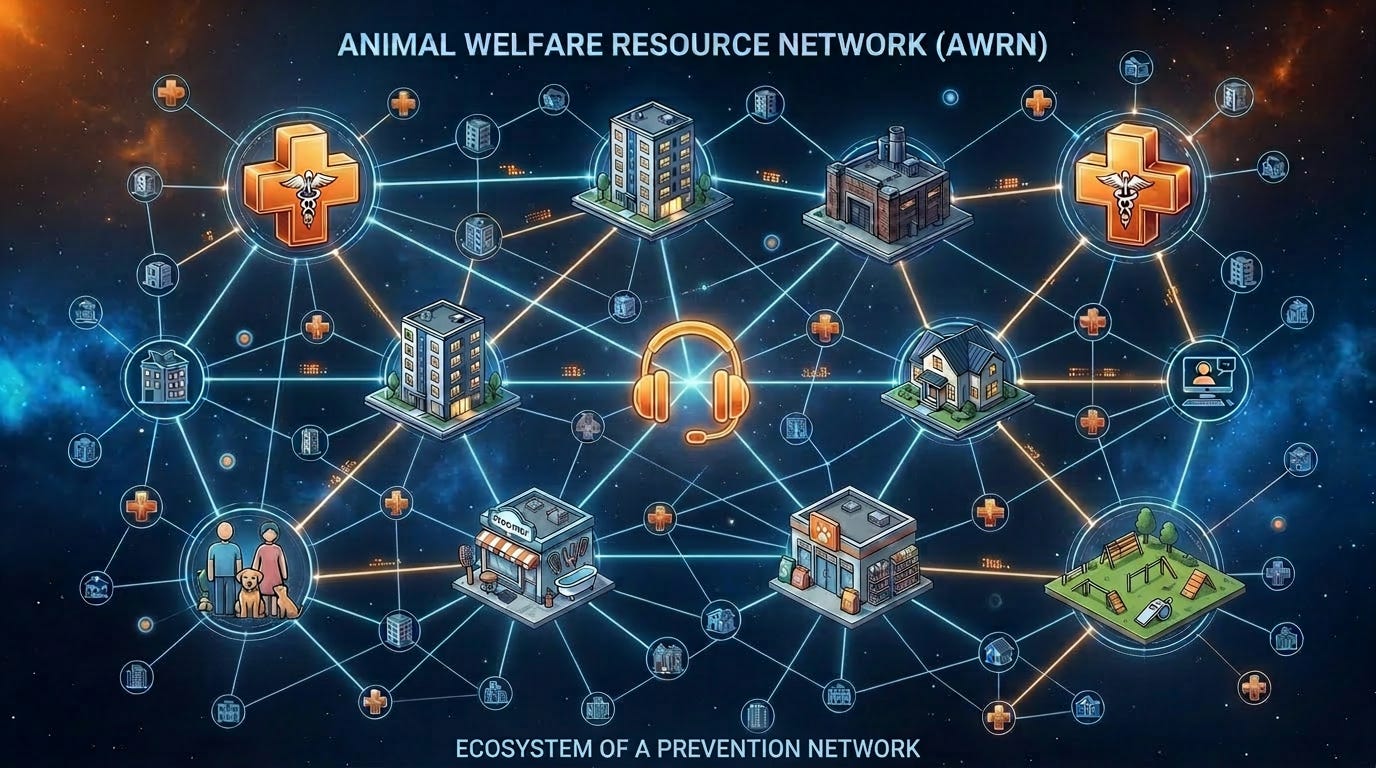
That is what prevention infrastructure looks like.
Prevention is not only upstream
The shorthand for prevention is usually upstream. Stop the surrender call. Spay the cat. Pay the vet bill before the family runs out of options. That work matters and it is the largest share of what the AWRN does. But it is not the whole picture.
Prevention is also what happens after the animal enters the system. The dog who comes into a shelter as a stray still needs a path back to her family or forward to a new one. The cat who lands in foster needs her behavior tracked so the adopter knows what they are getting. The hoarding case that turns into a managed rehoming needs every dog’s profile traveling with her, not starting from scratch at the next stop. If you lose the record at intake, you have lost the prevention work for everything that follows.
Prevention is also what happens after the adoption. The first ninety days after a family adopts is when most returns happen. A return is just another surrender wearing a different jacket. Adoption Boost catches the seven-day, thirty-day, sixty-day, and ninety-day check-ins. Training questions get answered. The vet referral gets made. The behavioral hiccup gets fixed before it becomes the reason the dog goes back.
The AWRN runs all three phases. We try to keep them out through prevention. The ones we cannot, we track end to end. When they leave through adoption, we track that for ninety days. Prevention is the through-line.
The handoffs between those three phases are where every other system in this industry loses the thread. The AWRN is built so the thread holds.
What HASS got right
The Human Animal Support Services initiative is a project of Austin Pets Alive!, funded by Maddie’s Fund, Pedigree Foundation, Rachael Ray Foundation, PetSmart Charities, Michelson Found Animals, and others. HASS published the prevention playbook. Four pathways. Pet Support Services. Lost Pet Reunification. Supported Self-Rehoming. Intake-to-Placement. Roughly twenty-three pilot shelters. One hundred sixty-five partner organizations.
HASS told the industry what to do.
HASS did not build the operational platform to do it together.
The Animal Welfare Resource Network (AWRN) is that platform. We are not competing with HASS. We are completing it.
The unified record underneath
On top of the six prevention programs sits the unified record. One animal, one record. One person, one record. One case across every partner organization the animal touches. The record travels. The handoff is not the moment the work disappears. The handoff is the moment the next partner sees everything that came before.
That is what makes prevention work hold across organizations. A surrender prevention call to Animal-Angels Foundation, at 3 a.m. does not vanish when the family moves to Colorado. A foster placement in Birmingham does not lose its training history when the dog transfers to a partner rescue. A spay/neuter recovery support payment in Sterling, Colorado is logged the same way as one in Trussville, Alabama.
Without that layer, prevention work resets at every handoff. The family gets asked the same questions again. The history evaporates. The next partner starts from scratch. That is the failure mode every existing tech platform has accepted.
We did not.
Who is on it today
It is not theoretical. Here is who is running prevention work through the AWRN right now.
Peaceful Coexistence Ltd, Sterling, Colorado
Peaceful Coexistence is a prevention-first dog welfare nonprofit serving rural northeastern Colorado. They run free training classes, free vaccines, and spay/neuter resources. They signed an MOU with AAF on April 27, 2026. They have been an active beta partner since May 1, 2026.
On May 6, 2026 at 7:08 PM Mountain Time, Haley Woods in Sterling, Colorado called PCE’s front desk needing Blue Buffalo dog food for her dog Blue. PCE had 4Health on hand. Michelle Mendoza, PCE’s founder, logged the call in the AWRN.
I am in Alabama. I saw the call in real time. Two states. One record. No friction.
That is not a tech demo. That is a real prevention call, a real family, a real shared system. PCE could not have built this on its own. AAF could not have validated this on its own. We needed each other to prove it works. It works.
Pet FBI
Pet FBI is the national lost and found pet database, running since 1998. On April 15, 2026, Leslie Poole and her team met with us and agreed to bidirectional data flow with the AWRN. Pet FBI pushes animal data to the AWRN. The AWRN matches against shelter intakes, owner alerts, and partner records across the network. Matches go back to Pet FBI. Pet FBI contacts the owner.
The MOU has been through their board with proposed revisions. We are finalizing it now. When it returns signed, the AWRN matching engine will run against twenty-eight years of lost and found pet data. That is the kind of partnership that nobody talks about because it sounds boring. It is also the kind of partnership that changes whether a lost dog in Ohio finds her family.
Best Friends Animal Society and Petco Love
Best Friends partnered with AAF as a Network Partner on May 2, 2026.
Petco Love activated AAF as an adoption partner on May 19, 2026. Adoption rewards. Twenty percent off supplies for every adopter. Sniff and Greet events at Petco store training rooms in Central Alabama.
These are the giants. They are partners. The framing that AAF is somehow opposing them is wrong. We are connected to them. The AWRN sits underneath the partnership. The records flow.
Academic backing
Jane Wei-Skillern of Berkeley Haas is a leading academic researcher on network leadership in the social sector. Her work argues the highest-impact organizations are the ones that prioritize mission over organization, share leadership, and build trust-based relationships across the ecosystem rather than empire-building. On a May 11, 2026 Maddie’s Fund Community Conversations call, she said it out loud. Build constellations, not stars.
She signed an endorsement letter for AAF’s network architecture.
Lawrence Minnis at George Mason University published the signal-to-noise framework for adoption decisions in Animals 2026 (DOI 10.3390/ani16081255). The framework explains why noisy adoption data leads to bad matches and why noise reduction at intake produces better outcomes. He is collaborating with us as a design partner on the Match Your Pet feature.
Sara Pizano, DVM, MA, author of The Go-To Guide for Animal Services, gave AAF a publication-ready endorsement and introduced us directly to Sheila Kouhkan at Maddie’s Fund.
The academic layer is not decoration. It is the difference between a Facebook post and a system.
Real prevention cases
Lisa Mitchell broke her hip and was hospitalized in Trussville, Alabama. She has a dog named Buddy. Her sister tried to give Buddy away while Lisa was in surgery. AAF placed Buddy in crisis foster with Danny Chaney within twenty-four hours, with paperwork in Buddy’s record that protected against third-party rehoming. The Bridge program caught the call. The AWRN held the record. Lisa is recovering. Buddy is fostered. Buddy is going home.
Nicole Rogers emailed AAF at 3:11 a.m. about her cats. Seven hours later, one hundred dollars in cat food was on her porch from Walmart. The Bridge program again. The case is in the AWRN. Future Bridge calls from Nicole link to the same case.
The Bessemer 20. Roughly twenty dogs at an elderly man’s property in Bessemer, Alabama. Managed Rehoming program. Each dog entered the AWRN. Status visible to rescue partners across the state. Some placed. Some still in process. The records hold.
These are not pilot stories. These are operational prevention stories. Every one of them is a surrender that did not happen because the platform caught the call.
What is coming June 1
On June 1, 2026 at 2:00 PM Eastern, Sheila Kouhkan and Maddie’s Fund are hosting a webinar through Maddie’s Fund Community Conversations “The Shift To Prevention”.
The same Maddie’s Fund that funds HASS is the platform where AAF will show the operational layer that makes prevention work across partner organizations. The introduction came from Sara Pizano. The recognition is real. The webinar is on the calendar.
The framing that animal welfare needs better tech is wrong. We have plenty of tech.
The framing that animal welfare needs facial recognition is wrong. Petco Love Lost has had it for years.
The framing that animal welfare needs a unified case management system is incomplete. Without prevention programs built into the platform, a case management system just makes the existing failure mode faster.
The missing layer is prevention.
We built the platform that runs it.
Stop asking who will built better tech.
Ask who built a platform that keeps families together.
We did.
Walk through it with us
If you want to see the AWRN in action, the easiest path is a thirty-minute Zoom walkthrough. Calendly.com/animal-angels.
If you would rather read first, the AWRN Information Booklet is at animal-angelsfoundation.org/downloads/AAF_AWRN_Information_Booklet.pdf.
If you run a shelter, a rescue, a vet clinic, a community organization, or a foundation that funds any of the above, the conversation is open. We are not competing for your animals or your dollars. We are offering the operational layer that makes both go further.
We do not compete. We connect.