


It is a Tuesday afternoon at a shelter you have been to. Day 47 for the brown dog in kennel 12. His intake notes say fearful, possibly reactive. His behavior assessment scored him low. He has been pacing for six weeks. The staff has tried. The dog has tried. The kennel has done what kennels do to a dog who has been in one too long. He is on the short list for behavioral euthanasia next Tuesday.
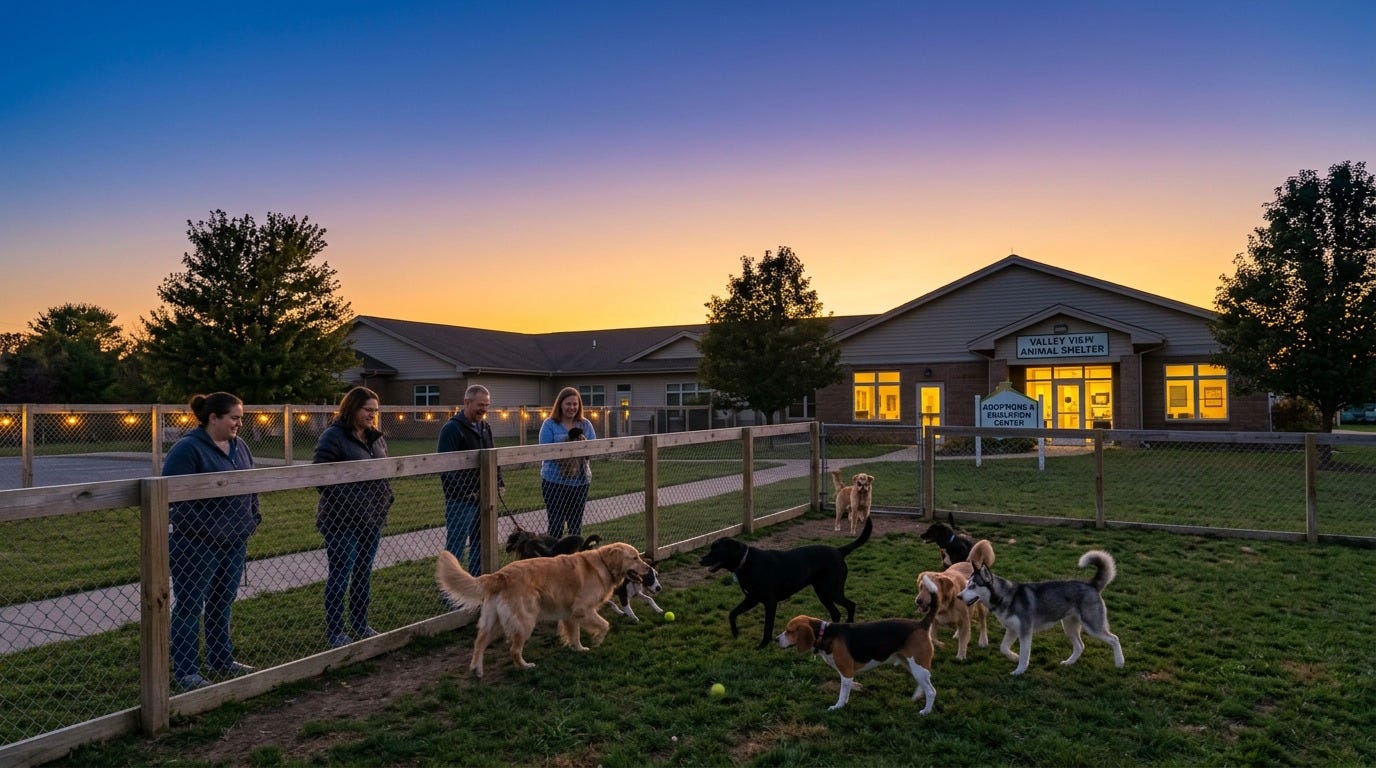
Then somebody puts him in a playgroup with three other dogs and a trained handler in an outdoor yard. He runs. He plays. He does a perfect play bow. He turns out to be a normal dog who could not show you that in a six-by-eight concrete box with a chain-link door.
That is not enrichment. That is prevention. The shelter just prevented the death of a dog whose behavior problem was the kennel.
The half of prevention nobody calls prevention
Most people in this field think prevention means stopping the surrender before it happens. Spay/neuter. Pet food pantries. Housing support. Vet care access. All of it upstream of the shelter, working to keep the family and pet together so the call never gets made.
That is one half of prevention. The other half lives inside the kennel.
Three organizations have spent the last decade building the operational playbook for the second half, and most of the field still files their work under enrichment in the budget.
What the three organizations actually do
Dogs Playing for Life, founded by Aimee Sadler, started training shelter staff in daily playgroups in 1998 and became a 501(c)(3) in 2015. They have worked with nearly 300 shelters across the country. Their Canine Center Florida runs the high-risk-population test case. An 84.7% live release rate as of December 31, 2024, with dogs originally flagged for euthanasia. The methodology is simple. Dogs come out of the kennel daily. They socialize in a yard before any training session. The energy that becomes anxiety or reactivity in a kennel becomes information when the dog is moving in a group. https://dogsplayingforlife.com/
The Shelter Playgroup Alliance, a 501(c)(3) operating a LIMA-based approach (least intrusive, minimally aversive), works with shelter teams on the smaller-scale version. Playgroup dyads and pairs as enrichment for dogs who actually enjoy play, paired with other forms of in-kennel and out-of-kennel enrichment for the rest. In 2022 alone, 679 shelters took part in their workshops. Their training covers inter-dog communication, body language reading, dog-dog introductions, fight intervention, and how to document what the dog tells you in the yard. https://www.shelterdogplay.org/
Shelter Behavior Integrations, run by Laurie Lawless, takes the model and threads it through every department in the shelter. Her Pathway Playgroups program treats playgroups as a purposeful piece of every dog’s journey from intake through medical through adoption through volunteer engagement. The data flow goes both directions. Intake informs the playgroup design. The playgroup informs the adoption match. The adoption match informs the foster pathway when the placement is not a match. Nothing is siloed because nothing in the dog’s life is siloed. https://laurielawless.com/
A multi-state interdisciplinary study of 172 dogs across four shelters confirmed what the practitioners already knew. Dogs in playgroups showed fewer problem behaviors. Less barking. Less jumping. Less whining. Less pacing. More adaptability. That is not just a happier dog. That is a dog the staff can read, that the adopter can meet honestly, and that goes home with information instead of a guess.
What changes when you call this prevention
Returns are the second surrender. The dog leaves the kennel with an adopter who was handed an inaccurate behavioral profile, because the only profile available was generated under kennel stress. Three weeks later the dog is back at the front desk. The adopter feels guilty. The staff feels defeated. The dog has now had two homes and a kennel stay sandwiched between them, and the second adoption attempt is statistically harder than the first.
The numbers say this is happening at scale. Studies put adoption return rates between 7% and 20%. In one shelter system, returns were the highest outcome type at 43.3%. Nearly 90% of returners cite behavior as the reason. Aggression alone accounts for 38.2% of returns. Over half of returns happen after the dog has been in the home more than 60 days, which is exactly long enough for an inaccurate match to fully unmask itself.
The dog in kennel 12 from the opening was about to be euthanized for behavior that was not his behavior, it was the kennel’s behavior on him. Adopters get told a story about the dog that comes from a setting where the dog cannot tell you who he is. Returns are the predictable downstream cost.
Playgroups change the upstream input. The dog gets read in a context that resembles the home he is going to. The adoption counselor has real data to work with. The adopter gets a match. The dog gets to stay.
That is prevention. The dog who stays is the dog who is not surrendered a second time. The family who keeps their match is the family who does not become the next surrender call. The shelter that gets its return rate down is the shelter that has more capacity for the next intake, which means more dogs out of the back end and into homes, which means fewer dogs sitting long enough to start showing the pacing behavior that puts the next dog on the short list.
The five things playgroups actually prevent
1. Behavioral euthanasia of dogs whose behavior was the kennel, not the dog. A trained handler with a yard and three other dogs gives you a behavioral picture no in-kennel assessment can produce.
2. Inaccurate adoption matches. The adopter sees the dog in a setting that resembles the one he is going to. The staff has real data, not kennel-stressed data, to make the recommendation.
3. Returns at 60 days. Behavior surfaces in the first 60 days of a placement. If the match was wrong, the dog comes back. If the match was right, the dog stays. Playgroups improve the inputs to the match.
4. Length of stay. Dogs who can be read accurately move through the shelter faster. Dogs who sit longer show more of the behavior that keeps them sitting longer. Playgroups break that loop.
5. Staff burnout. The staff member who spent six weeks watching kennel 12 pace and then put him in a playgroup and saw him bow is the staff member who comes back tomorrow. Dogs who decompensate in kennels burn out the people taking care of them.
Each of these is a prevention metric. Each of them reduces a downstream cost the shelter is currently absorbing. Each of them is being tracked, somewhere, by one of the three organizations above. Most shelters are not tracking them as prevention because the field’s vocabulary calls this work enrichment.
Vocabulary moves money
The word enrichment puts this work in the discretionary budget line. The word prevention puts it in the operational line. The word enrichment makes it the first cut when the budget tightens. The word prevention makes it core operations.
We do not have a return problem. We have a prevention problem inside the kennel that no one has named correctly. The three organizations doing this work have been telling us for a decade. The field has been listening to the part about happier dogs. The field has not been listening to the part about how the dog who is read accurately is the dog who stays.
Playgroups help dogs get adopted. They also help dogs stay adopted. That second half is prevention, and the only reason it does not look like prevention is that we have been calling it something else.
If your shelter is doing this work, I want to hear how you measure it. If you know somebody at your county budget meeting who needs to read this, forward it. The vocabulary change starts with the people willing to use the new word.
Join the Shift to Prevention.
BJ Adkins, Founder, Animal-Angels Foundation, animal-angelsfoundation.org
Sources
Dogs Playing for Life. Impact Report. dogsplayingforlife.com/impact-report (84.7% live release rate at Canine Center Florida, December 31, 2024). Aimee Sadler founder bio and 1998 start: dogsplayingforlife.com.
Shelter Playgroup Alliance. Mission, LIMA approach, 2022 workshop participation (679 shelters). shelterdogplay.org. Also: IAABC Foundation Journal, The Shelter Playgroup Alliance, journal.iaabcfoundation.org/shelter-playgroup-alliance.
Shelter Behavior Integrations by Laurie Lawless. Pathway Playgroups program description. laurielawless.com/pathway-playgroups and laurielawless.com/blog/how-playgroups-benefit-shelter-dogs.
172-dog multi-state playgroup study referenced via Maddie’s Fund, Do Playgroups Increase Behavioral Welfare in Shelter Dogs. maddiesfund.org/do-playgroups-increase-behavioral-welfare-in-shelter-dogs.htm.
Adoption return rate range (7% to 20%): Factors Informing the Return of Adopted Dogs and Cats to an Animal Shelter, ncbi.nlm.nih.gov/pmc/articles/PMC7552273. Also Characterizing Unsuccessful Animal Adoptions, nature.com/articles/s41598-021-87649-2.
Behavior as reason for return (approximately 90% of returners, aggression 38.2%): Characterizing Unsuccessful Animal Adoptions, pmc.ncbi.nlm.nih.gov/articles/PMC8044234.
60-day return timing (over half of dog returns occur after the dog was owned more than 60 days): Factors Informing the Return of Adopted Dogs and Cats, ncbi.nlm.nih.gov/pmc/articles/PMC7552273.