


Here are one organization’s numbers for its first year. Fifty-nine vet visits. Seventeen spay/neuter surgeries. Fifty-four vaccinations. Eleven new dog houses. One hundred forty-one bags of food. Two hundred forty-two doses of flea, tick, and heartworm preventative.
In the same city, in the same year, the municipal shelter took in more than twenty thousand animals.
By every scale measure animal welfare uses, that first list is a rounding error. Seventeen surgeries would not move a single number on a county dashboard. It is also the most useful thing I have read about prevention this year, and the reason has nothing to do with scale.
What they actually do
Underdogs of Philly, the Outside Dog Initiative, became a nonprofit in September 2025. Cara Brand and Caroline Lipinski co-founded it and run it as co-presidents. Brand teaches genetics at Rutgers. Lipinski is a fundraising consultant. Each of them had already put in about five years volunteering in Philadelphia animal welfare, including at ACCT, the city’s animal control shelter. Roughly thirty volunteers. No paid staff. The money comes almost entirely from the people who follow them on social media.
They work three neighborhoods, Strawberry Mansion, West Philadelphia, and Kensington, mostly on weekends. They visit about thirty dogs at least once a month. The dogs live outside.
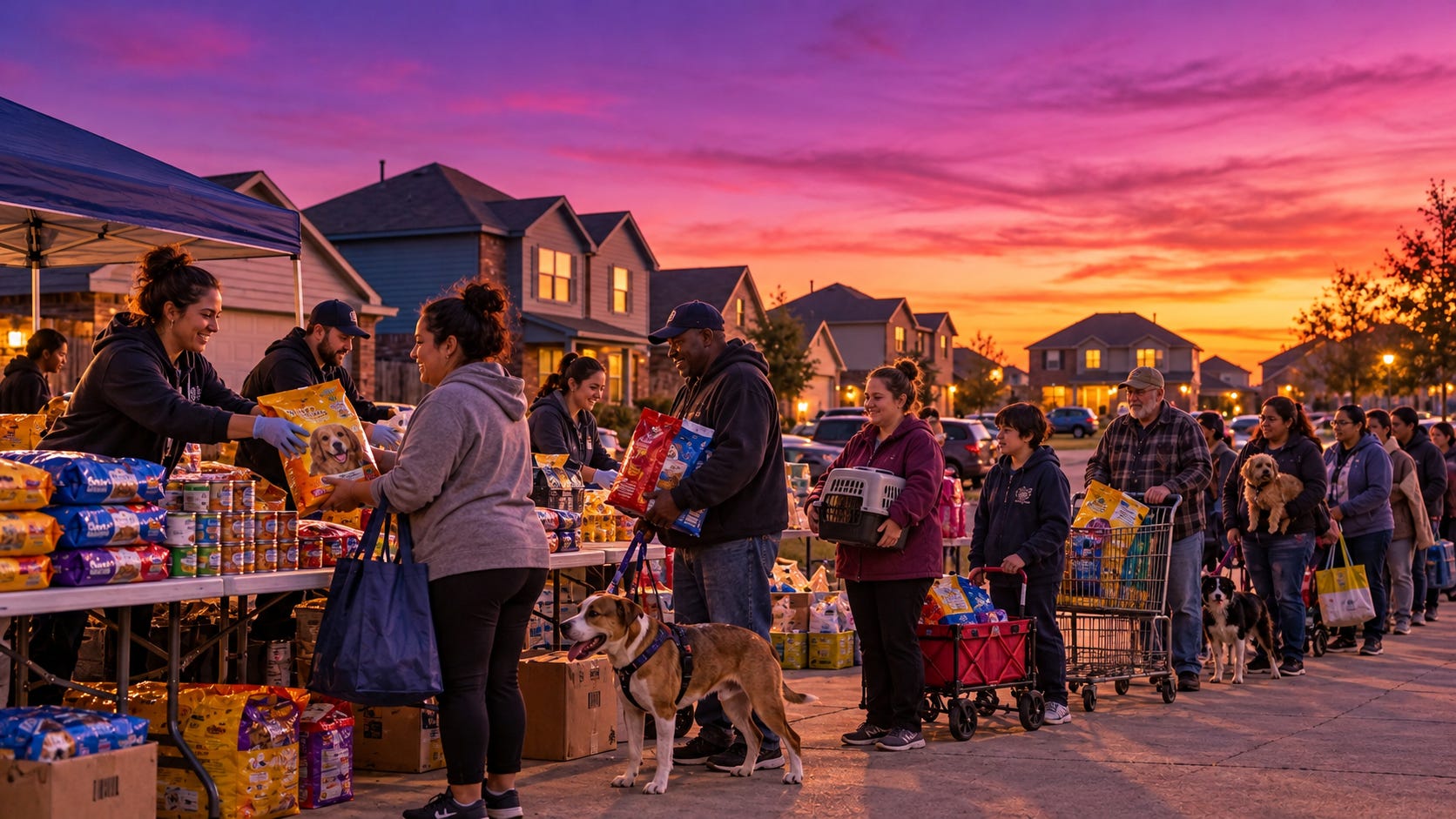
The work, as the Philadelphia Citizen reported it this month, looks like this. Food. Straw in the winter. Flea, tick, and heartworm preventative. Dog houses, fence repairs, yard cleanup. Sun shades and fly traps in the summer. Rides to PAWS three times a year for a wellness check, vaccines, and spay/neuter. A boarding partner in Fishtown where a dog can recover after surgery. Day trips to a daycare so a dog that lives alone in a yard gets a few hours around other dogs. Groceries for the person, when the person needs groceries. Emergency shelter for a dog whose house burned. Crates, for the owners who decide they want the dog inside and need a way to make that work.
And they say, plainly, that they are “not a rescue.” Lipinski has been firm about that since they started. When a dog has to leave a home, they connect the owner to a rescue. They are not in the business of taking dogs.
That is the same sentence AAF uses, from a group eight hundred miles away that has never heard of us.
Philadelphia is not a city without prevention programs
Here is the part worth writing about.
Philadelphia already runs prevention. ACCT Philly has a Help Desk for residents who need help with a pet or are thinking about surrender. It has a Pet Pantry that gives out free pet food. It runs short-term boarding through its P.E.T.S. Fund, one to four weeks at partner facilities, for owners who have a date to take the dog back. Those are real prevention programs, run by a shelter that took in more than twenty thousand animals in 2025 and ranked seventeenth in the country for intake the year before.
Now read how a family gets to them.
The Help Desk starts with an online Request for Assistance form. Somebody contacts you after you submit it.
The Pet Pantry starts with an online request form and an appointment. To qualify you have to be a Philadelphia resident with valid ID or proof of address, show verification of income with something like a pay stub or a benefit letter, and provide proof of spay/neuter for all pets at your residence. One pickup a month. Supplies go out first-scheduled, first-served, and the page says availability is not guaranteed.
Short-term boarding starts with the same Request for Assistance form.
Every one of those doors opens from the resident’s side.
I am not writing that as a shot at ACCT. Eligibility screening is cheap and outreach is expensive, and a shelter absorbing twenty thousand animals a year is not sitting on spare capacity to drive around Strawberry Mansion on a Saturday. When a system is under that kind of load it builds forms, because forms are what you build when demand exceeds supply and somebody has to allocate. The form is doing exactly what it was designed to do.
The form is also the barrier, and the households furthest from help are the ones least able to clear it.
The gate that screens out the case prevention is for
Look at the food requirement again, because it is the cleanest example I have found of how this goes wrong without anyone intending it.
To get free pet food from the city shelter, you have to prove every pet at your address is already sterilized.
The household that needs free pet food most is the household feeding a litter.
That requirement is defensible. A pantry with limited supply does not want to subsidize breeding, and conditioning food on sterilization is a reasonable way to protect a scarce resource. I understand why the rule is there. But run it forward one step. The family with three unsterilized dogs and no money for food cannot get the food, and nothing in that interaction gets a single dog sterilized. The gate screens out the exact case the program exists to solve.
Underdogs runs the same lever from the other end. Monthly food delivery is offered to owners who agree to spay or neuter. Straw goes to everybody, no conditions.
Same incentive. Opposite starting assumption. One requires the behavior before the help. The other uses the help to get to the behavior. The second one costs more, takes longer, and is the only one of the two that can reach a family that has not already complied.
The number nobody funds is the eleventh visit
Lipinski has described the first knock as the thing that matters most, and the posture as deliberately not judging, not threatening, and not enforcing. They lead with food. Then they come back.
She has also described trust-building that can run two or three years with a single owner, a slow grind where you keep showing up and the situation improves by degrees. Brand describes the work as iterative, each visit leaving the dog a little better off than the visit before.
There is no grant line for that. You cannot report visit nine of an expected fifteen on a quarterly form. The sector counts surgeries, pounds of food, bed nights, and live release rates, because those can be counted. What Underdogs produces is a relationship that makes the surgery possible later, and that is why seventeen surgeries and a working model sit in the same annual report with no contradiction.
Seventeen surgeries is not the output. Thirty doors that open now, because somebody knocked eleven times, is the output. The surgeries come out the far end of that, and the count will climb, because the hard part is already finished in those thirty households.
What the law can reach, and what it cannot
The other thing worth taking from Underdogs is about enforcement, and it is the part advocates most often skip.
Pennsylvania requires that an outdoor dog’s shelter be sufficient to preserve the dog’s body heat. It does not specify how the thing is built, whether it sits up off the ground, or how the entrance is cut. A plywood box with gaps in it can satisfy that standard. A dog on a chain with food, water, and shelter is legal.
So an officer who shows up at that yard has nothing to act on, and leaves.
Underdogs shows up at the same yard and starts fixing the box, trading the chain for a lighter cable, adding a sun shade. Lipinski’s framing, and I am paraphrasing her, is that what is legal is not necessarily what is best.
That is the whole gap in one sentence. Enforcement reaches the illegal. Everything between legal and good takes somebody showing up voluntarily, repeatedly, with no authority and nothing to hold over anybody, carrying straw.
Philadelphia is not a city that refuses to act upstream, either. City Council passed a breeding moratorium, Bill 250989, signed in March and effective in June of this year. That is real policy and it addresses supply. It also does nothing this winter for three unsterilized dogs in a yard whose owner cannot get pantry food because the dogs are unsterilized. Policy sets the rules. Somebody still has to drive over.
Brand has pointed to Dog Aid in Michigan as the group they learned the approach from, which is worth knowing. Knocking first is not a Philadelphia invention. It is a model that keeps getting rebuilt by people who go looking for it, each time from scratch.
Where AAF has the same problem
AAF has the same structural problem ACCT has, and I would rather say that out loud than pretend our version is different.
The Pet Help Desk is a phone number. A phone number is a door that opens from the caller’s side. Every case we have opened started with somebody deciding to pick up the phone, or a social worker or a shelter deciding to send them to us. That is a real service and it works for the family that calls. It does nothing for the yard four streets over where nobody is going to call anyone.
We have not built the knock.
What we have built is the part Underdogs does not have. Thirty volunteers can hold about thirty relationships, and that ceiling is hours, not willingness. If they opened a fourth neighborhood tomorrow, the relationships would be new and so would the referral map, and somebody would have to learn from scratch which clinic has openings, which pantry has food this week, which vet will take a payment plan. Right now that knowledge lives in two founders’ heads and a volunteer group chat.
That is what the AWRN is for. The point of a coordination layer is that the volunteer standing at the door does not have to be the person who knows everybody. They log the household, flag the litter, and the network routes it to the clinic, the pantry, and the vet. Coordination is the part that scales. Trust is the part that never will.
Neither half works alone. A referral network with nobody knocking is a website. Thirty people knocking with no network behind them is thirty households, which is thirty more than zero and a hard ceiling either way.
The formal system in Philadelphia knows what families need. It published the list. Then it waits for the family to find the page, fill out the form, prove their income, and prove that the problem the program exists to solve has already been solved.
Two volunteers decided the waiting was the problem, and started knocking.
Support should begin before separation. Somebody has to go first.
Join the shift to prevention.
Donate to Prevention and fund what happens before the shelter.
Animal-Angels Foundation
angels@animal-angels.org
animal-angelsfoundation.org
Connect with us:
LinkedIn: linkedin.com/company/animalangels
Facebook: facebook.com/animalangelsfoun
Instagram: instagram.com/an.gels377
Animal-Angels Foundation Inc
A 501(c)(3) public charity
Tax ID 41-3166394
We welcome DAF and QCD gifts.
Serving Jefferson, Shelby, Blount, St. Clair, Walker, Bibb, and Chilton counties in Central Alabama.
Pet Help Desk: (205) 754-7542
Email: angels@animal-angels.org
Mail: 4906 Vise Road, Pinson, AL 35126
Web: animal-angelsfoundation.org
Donate: animal-angelsfoundation.org/Donate.html
By Animal-Angels Foundation, a prevention-first 501(c)(3).
Sources
Lauren McCutcheon and Hailey Rauso, “Meet the Real Underdogs of Philly,” The Philadelphia Citizen, October 8, 2026. First-year activity counts, founding date, founders’ backgrounds, volunteer count, neighborhoods, and the list of services. thephiladelphiacitizen.org/meet-the-real-underdogs-of-philly/
Underdogs of Philly, underdogsofphilly.org. Organization description and service categories. Registered as Underdogs of Philly, the Outside Dog Initiative, EIN 41-2577077.
Penny Ellison, “Outside Dogs and the Law: How Support Keeps Dogs Out of Shelters,” The Animal Advocate podcast, Animal Advocacy Academy, June 2, 2026. Interview with Cara Brand and Caroline Lipinski. Source for the not-a-rescue position, the first-knock posture, the multi-year trust timeline, the conditional food and unconditional straw, the Pennsylvania shelter standard, the Philadelphia breeding moratorium, and the Dog Aid reference.
ACCT Philly, “Keeping My Pet” and “Pet Pantry,” acctphilly.org. Help Desk, Pet Pantry, and P.E.T.S. Fund access process and the three Pet Pantry eligibility requirements as published.
ACCT Philly, “Statistics and Reports,” acctphilly.org. 2025 intake above twenty thousand, seventeenth nationally for intake in 2024, 87 percent live release.
Philadelphia City Council Bill 250989, breeding moratorium, signed March 2026, effective June 2, 2026.