


Every fall the national shelter numbers come out, and every fall there is a headline worth celebrating. This year it was cats. Shelter Animals Count, the national database run as a program of the ASPCA, reported that shelters and rescues adopted out one million cats in the first half of 2026. That is 20,000 more than the same stretch last year and 117,000 more than in 2016. Adopters showed up. Shelter staff did the work. That deserves to be said first, and said plainly.
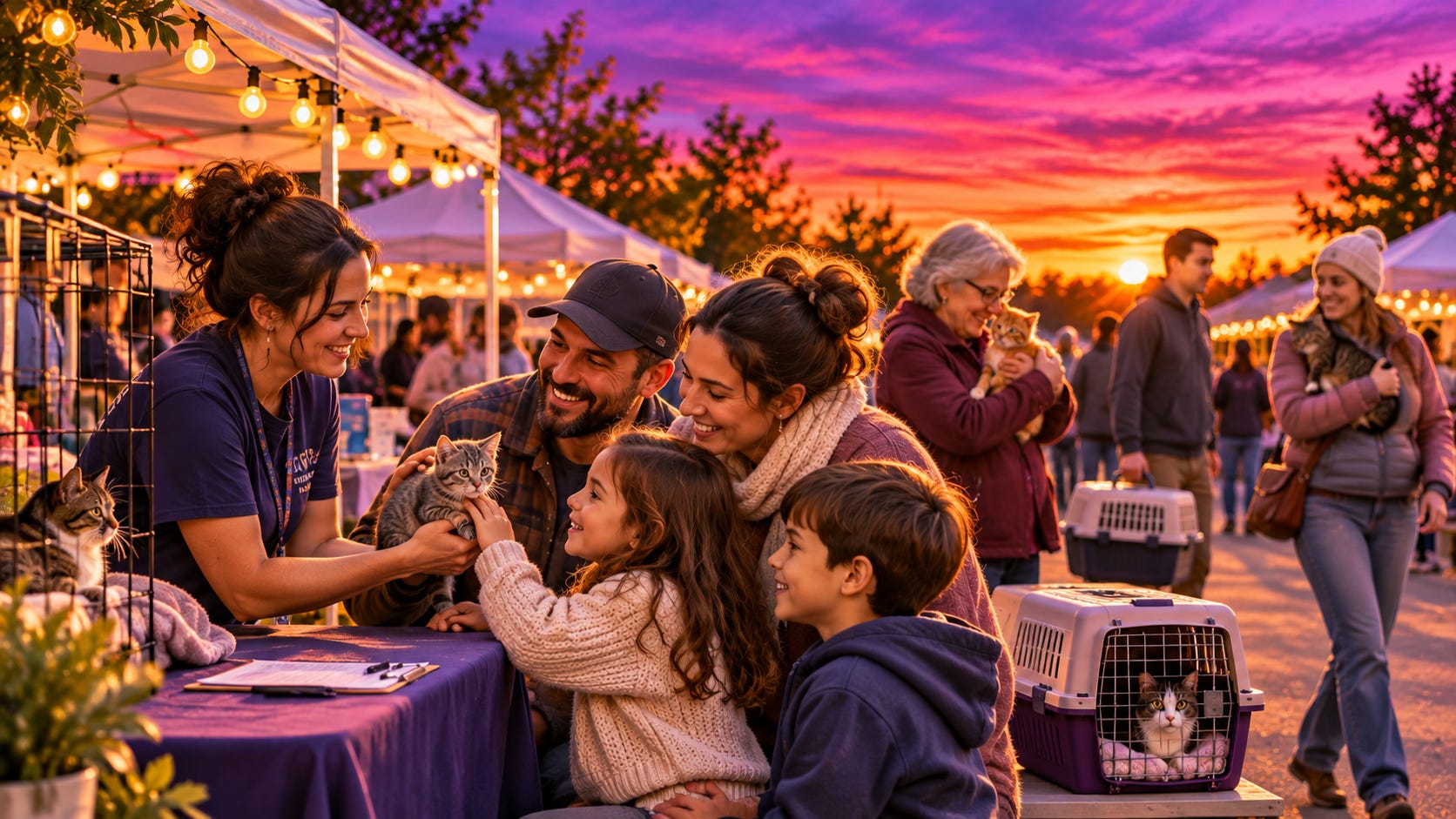
Now read the next line in the same report. Cat intake rose by 59,000 animals, up 3.5 percent, and that one jump accounts for nearly all of the national increase. Dog intake held about flat. Total intake hit 3.7 million cats and dogs in six months.
Record adoptions and rising intake, at the same time, for the same species. If you want the whole argument for prevention in one chart, that is the chart.
Where the cats are coming from
The report does not say why cat intake went up. It does tell you who walked in the door. Shelters took in 674,000 kittens in the first half of the year, and juvenile cats reached the highest mid-year total on record. Kittens are not surrendered because a landlord changed the rules or a vet bill came due. Kittens arrive because an adult cat somewhere was never fixed.
That is the part the adoption number cannot touch. Adoption is downstream work, and right now it is downstream work done well. But every kitten placed in July makes room for a kitten born in August to an unaltered mother three streets over. You can run the adoption side flawlessly and still lose ground, because the inflow is set by how many cats get spayed, not how many get adopted.
And spay/neuter is exactly where the system is jammed. A University of Florida survey of shelters found 91 percent of the 143 that answered had a surgery backlog, with a combined 18,648 animals waiting. Advocates now estimate a national backlog in the millions of surgeries that never happened after the pandemic shut down nonessential vet care. In the neighborhoods with the least access to care, the share of pets that are fixed is often a quarter or less. One national study of low-cost clinics found that 22 percent of female cats and dogs had already had a litter by the time they made it to their spay appointment. The wait is not a delay. The wait is the litter.
Somebody already proved this works
This is not a theory. It has been tested, and the results are about as clean as animal welfare data ever gets.
In one Florida county, researchers picked a single zip code with a long history of high cat intake. Over two years they trapped and fixed 2,366 community cats there, roughly 54 percent of the estimated population, adopted out the friendly ones, returned the rest, and gave neighbors education and help with nuisance complaints. Shelter cat intake from that zip code dropped 66 percent. The rest of the county barely moved.
Then it was scaled. A study of community cat programs at six municipal shelters in very different cities, covering 72,970 cats over three years, found a median 32 percent drop in feline intake and an 83 percent drop in feline euthanasia. These were not boutique programs. They were run by public shelters, the same kind of agency most counties in Alabama already pay for.
Running it through the lens
Is a community cat program prevention? Yes. It works on the cause, the next litter, instead of the result. Does it work? The best evidence in the field says it does, and says it works fastest when you aim it at the neighborhoods that send the most cats in instead of spreading it thin.
What does it miss? Two things. First, most of these programs target unowned cats. The owned cat in a family that cannot afford a 150 dollar surgery, or cannot get to a clinic two counties over, often falls through the gap between TNVR and a full-price vet. Those families are having litters too. Second, these programs run on surgery capacity, and that capacity is exactly what the backlog says we do not have. A trap is only as useful as the next open surgery slot.
Where does it fit? It is a load-bearing wall that most communities have built as a patch. It usually runs on volunteer time and a grant, while the kennel budget runs on tax dollars every year. That is backwards. The program that bends the cat intake line is treated as optional, and the building that absorbs the result is treated as essential.
What the full version looks like
Take what the research already proved and fund it like infrastructure. Pick the zip codes that send the most cats in, because the data says that is where the drop happens. Pair TNVR for community cats with surgery that owned-cat families can actually afford and actually reach, including transport or clinic days in the places with no vet nearby. Buy surgery capacity on purpose, through high-volume clinics, vet partnerships, and contracts sized to the need instead of whatever is left over. And track intake by zip code, so a commission can see the line bend and know its money did that.
Shelters just proved they can place a million cats in six months. They should not have to do it again next year because nobody paid for the surgeries that would have kept those kittens from being born.
If one person in your life is still arguing that adoption events will fix this on their own, send this. Either the math changes their mind, or they have to explain why it doesn’t.
Join the shift to prevention™.
Donate to Prevention and fund what happens before the shelter.
Animal-Angels Foundation
angels@animal-angels.org
animal-angelsfoundation.org
Connect with us:
LinkedIn: linkedin.com/company/animalangels
Facebook: facebook.com/animalangelsfoun
Instagram: instagram.com/an.gels377
Animal-Angels Foundation Inc
A 501(c)(3) public charity
Tax ID 41-3166394
We welcome DAF and QCD gifts.
Serving Jefferson, Shelby, Blount, St. Clair, Walker, Bibb, and Chilton counties in Central Alabama.
Pet Help Desk: (205) 754-7542
Email: angels@animal-angels.org
Mail: 4906 Vise Road, Pinson, AL 35126
Web: animal-angelsfoundation.org
Donate: animal-angelsfoundation.org/Donate.html
By Animal-Angels Foundation, a prevention-first 501(c)(3).
Sources
ASPCA, Shelter Animals Count releases 2026 Mid-Year Data Summary (October 6, 2026): https://aspca.org/about-us/press-releases/shelter-animals-count-releases-2026-mid-year-data-summary-and-new
Shelter Animals Count, 2026 Mid-Year Report: https://www.shelteranimalscount.org/2026-mid-year-report/
UF Shelter Medicine, The nonprofit veterinarian shortage (backlog survey): https://sheltermedicine.vetmed.ufl.edu/2024/11/06/the-nonprofit-veterinarian-shortage-who-will-care-for-the-pets-most-in-need-3/
UGA PAWS, spay/neuter backlog and alteration rates:
https://paws.law.uga.edu/?p=1809
Research Square, access to care study (first vet visit and prior litters at spay/neuter): https://www.researchsquare.com/article/rs-3915925/v1
Levy et al., Effect of high-impact targeted trap-neuter-return, The Veterinary Journal (2014): https://pubmed.ncbi.nlm.nih.gov/24980808/
Faunalytics summary of the Levy study: https://faunalytics.org/effect-of-high-impact-targeted-trap-neuter-return-and-adoption-of-community-cats-on-cat-intake-to-a-shelter/
Spehar and Wolf, community cat programs at six municipal shelters, Frontiers in Veterinary Science (2019): https://www.frontiersin.org/articles/10.3389/fvets.2019.00077/text
The national backlog figure is an advocate estimate reported by UGA PAWS, not a measured count. The 150 dollar surgery cost is an illustrative round number for a full-price private-practice cat spay, not a sourced average.
Right on point BJ. The remaining barriers include a growing veterinary workforce shortage that better budgets alone cannot impact. Some low-cost clinics have given up spay/neuter altogether because they've been unable to recruit a vet, especially to rural areas. Others have replaced some of their spay/neuter days with preventive medicine appointments. Some spay/neuter clinics gave up and closed. It's a rough time for low-cost clinic sustainability. Here in Florida, voters just passed a constitutional amendment to significantly cut back residential property taxes. We don't have an income tax. Counties will adapt by funding human life safety programs first. Fire, law enforcement, EMS will be top priorities, followed by many other departments. Animal control divisions, with their relatively small operations, are likely to be prioritized near the bottom and to experience significant cuts. Municipal shelters are bracing for the budget cutbacks they know are coming. Some rural counties have announced they may close their shelters entirely, leaving residents with no options at all. It's likely that the preventive programs like public spay/neuter and TNR will be downsized or eliminated as the shelters shrink operations back to the bare minimum of controlling dangerous dogs.