


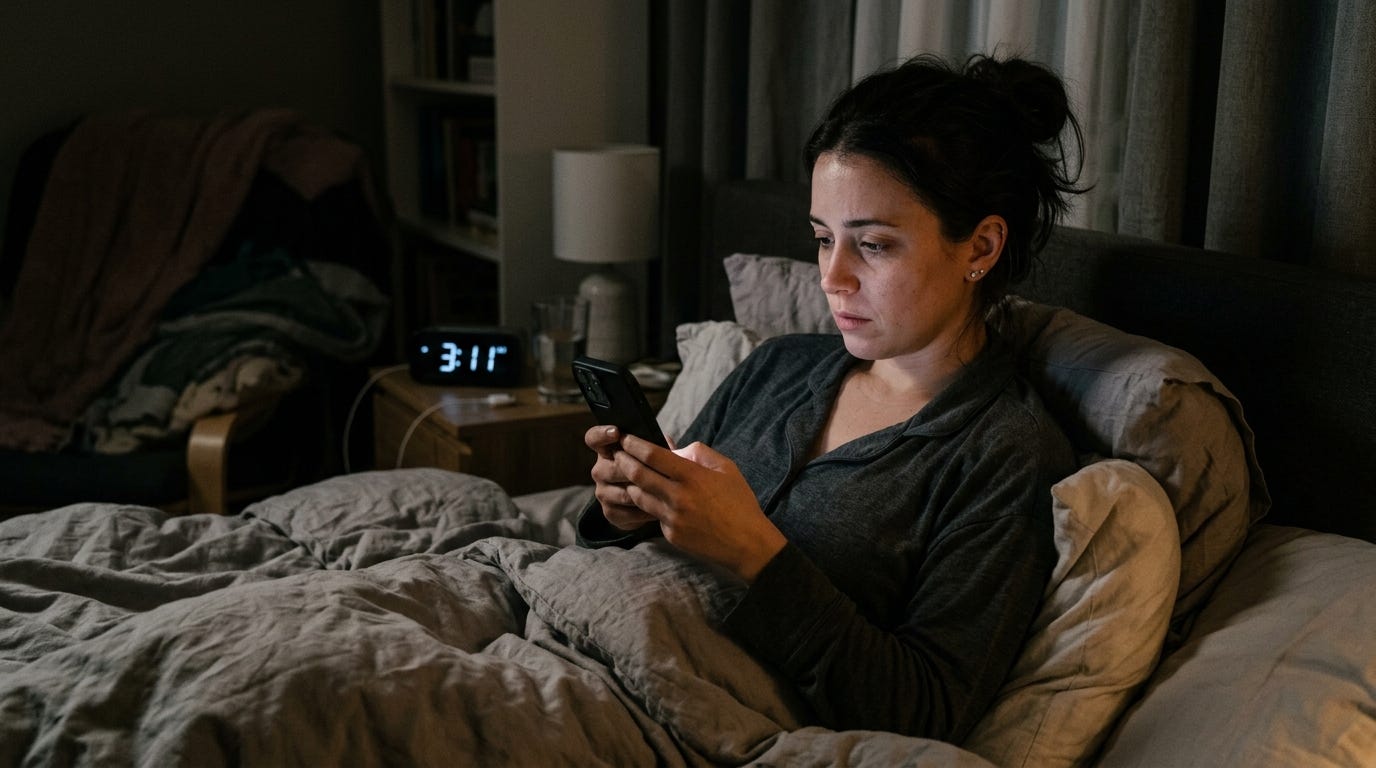
The email came in at 3:11 in the morning. I was awake. Most of you who follow this work already know I am awake at that hour more nights than not, which turns out to be the only reason I saw it before sunrise.
The first line stopped me.
It is currently 3:11 a.m., and I am in such turmoil I just cannot stay asleep.
Her name is Nicole. She lives in St. Clair County. She has been out of work for five months because of medical issues she does not need to explain to anyone. She has kids. She has been navigating a stretch of life that would break most people, and she had stayed inside of it without dropping anything important.
Except the cat food.
Scone and Muffin
Two cats. Scone is gray and white, about seven pounds, with a habit of slipping outdoors for a day or two before coming home. Muffin is brown and black, about thirteen pounds, an indoor cat by personality and choice. The kids call them Skinny Scone and Stuffin’ Muffin. They were adopted at a Halloween trunk-or-treat almost two years ago at a vet clinic that did the kind of recruiting most shelters dream of doing.
Nicole loves these cats. She wrote about them the way someone writes about family. The kind of email you would not write to a stranger if the situation was anything less than full crisis. She had been out of cat food and decent litter for a week and a half. The cats had started getting into the fridge looking for anything edible. She wrote that she could not even get mad at them, because she knew how hungry they were.
Her power bill was three hundred dollars past due. The disconnection notice was for that same day. She had been awake at 3:11 a.m. because that is when the math of a five-month medical leave with three kids stops feeling like a problem you can solve in the morning and starts feeling like a problem that is going to swallow everything.
She had been referred to Animal-Angels Foundation by another local organization. She sat down to email us at 3 a.m. because she did not expect to hear back until business hours and she needed to write it while she could still string sentences together. She apologized in the email for being long-winded. She told us she loves these cats. She told us about a rescue dog she had been holding for a neighbor and a turtle she had pulled out of a bad situation. She told us she did not have a vehicle and would trade food stamps for gas money if anyone could drive her somewhere.
We did not need any of that.
What Happened Next
I opened a Walmart order at 3:30 a.m. Twelve pounds of dry cat food, two bags of litter, a few cans of wet food because every cat deserves wet food sometimes. Total around one hundred dollars. Delivery scheduled for the next morning to her address in Pell City.
By 10 a.m., Walmart had delivered. Scone and Muffin had food and litter before Nicole even got back from dropping her daughter at a medical appointment. The cats did not have to go another day hungry. Nicole did not have to add cat food to the list of things she was triaging that morning.
Total turnaround time from the email arriving to the food on the porch: seven hours. Total cost to AAF: about one hundred dollars.
The Part Most People Miss
If Animal-Angels Foundation had not existed, here is what was on the table for Nicole the next morning. Either she found a way to come up with cat food money while also trying to keep the power on and her kids stable, or she would have started thinking about whether the cats had to go. She would not have wanted to think about it. She probably would have hated herself for thinking about it. But she would have been forced to think about it, because the math was not adding up and something had to give.
The math of pet surrender is not complicated. It is housing pressure, medical crises, and the cost of pet food landing on the same family in the same month. When all three hit at once and there is nobody to call, the pet is the line item the family can let go of even though they do not want to. That is how most shelter intakes start. Not with families who stopped loving their pets. With families who ran out of options.
Nicole did not run out of options because Animal-Angels Foundation existed at 3:11 a.m. on a weeknight. The system that gave her one hundred dollars in cat food and litter inside of seven hours is the system we have spent six months building. It is called The Bridge. It is the part of the AAF model that catches families before they hit the shelter door.
Why I Am Writing This Down
Most families in Nicole’s situation never write the email at all. They look at the same math she was looking at, decide there is nowhere to ask, and either surrender the pet or hide the crisis until it forces a decision. The Bridge only works if families know it exists, and the families who need it most are the families least connected to the kind of network that would tell them.
Writing Nicole’s story down does two things. It tells the families reading this newsletter who are in their own version of Nicole’s situation that there is somewhere to email at 3 a.m. and someone will see it. And it tells the people who fund this work that the dollars are landing in exactly the kind of place they hoped they would land.
The Walmart order for Scone and Muffin cost about one hundred dollars. That is one Bridge case. Animal-Angels Foundation has handled dozens like it across our seven-county service area since we became operational. Every one of them has the same shape: a family that loves their pet, a crisis they did not see coming, and a hundred dollars between staying together and not.
If You Want to Fund the Next One
The Bridge runs on donations. We do not get to predict when the next 3:11 a.m. email is coming, and we do not get to ask the family to schedule the crisis around our fundraising calendar. The infrastructure either has money in it when the email arrives, or it does not.
Right now it does, because of the people who have already given. A hundred dollars from a donor became cat food and litter for two cats and one less weight on a family that was carrying too many. That is the entire model.
If you want to be part of the next email getting answered, the donation page for the Bridge Fund is at https://animal-angelsfoundation.org/BridgeFund.html. Every dollar that lands there is a dollar waiting for the next 3 a.m. message. Every dollar that lands there is a family who will not have to choose between their power bill and their cat food.
We do not always get to know what happens to the families after we ship the supplies. Sometimes we do. Nicole texted back after Walmart delivered. She said her kids cried. She said she did not have words. We told her she did not need any. The cats had food and the family was still together. That was the whole point.
It is currently 3:11 a.m. for somebody right now. Somewhere in our seven counties, and somewhere in counties we have not reached yet, another family is staring at the same math Nicole was staring at and trying to decide whether to send the email. We want to be there when they do.
Every dollar funds the next emergency response. Direct, immediate, no overhead skimming.