


Everybody in Blount County has seen it. A box at the end of a driveway. A skinny dog trotting the shoulder of a county road with no collar and nowhere in particular to be. A cat living under a porch with her third litter of the year, and the family inside who feeds her every single night and cannot afford what it would cost to make that litter the last one.
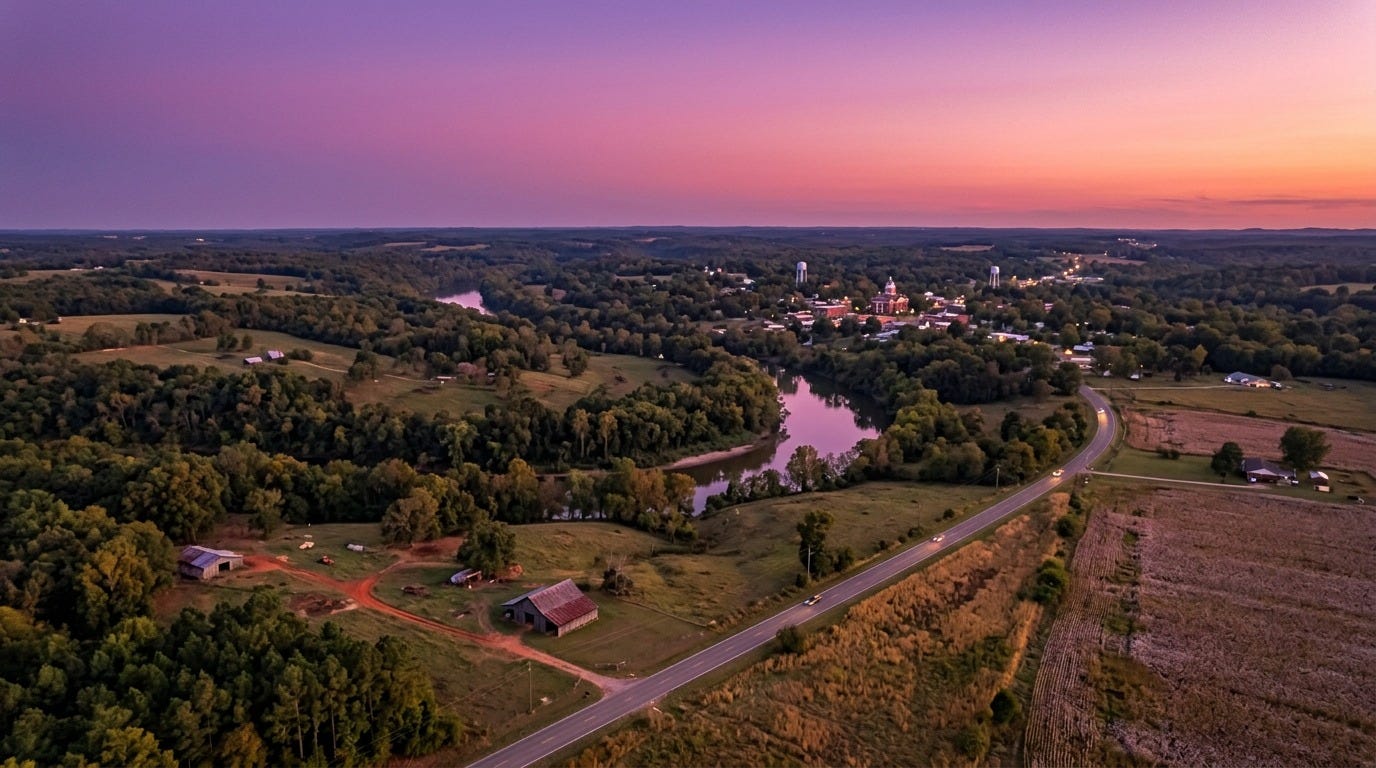
None of that happens because people here do not care about animals. It happens because this is a rural county, and out here the cost of a spay or a neuter lands on families who are already stretched thin. Then add the distance. Blount County has four veterinary practices for about sixty thousand people, spread across a county you cannot cross in a hurry. That is nothing against those four. They are carrying a load built for a dozen. But if you do not have reliable transportation, or you do not have gas money this week, a clinic thirty or forty minutes away may as well be in another state. So a lot of animals in this county never see a veterinarian at all, much less for a surgery that would stop the next litter.
And when a family runs out of road, the back roads are where the animals end up. Not because people around here are cruel. Because the shelters are already packed past capacity and cannot take another one, and a county road at dusk starts to feel like the only door left open. Then those animals have litters, and those litters have litters. We joke that Alabama has four seasons: fall, winter, kitten season, and kitten season. Nobody in this county is laughing by June.
The numbers back up what people already see. Owner surrenders in Blount County have roughly doubled since 2022, and more than half of everything coming through the shelter door is under six months old. That is not a mystery. That is a math problem nobody has been handed the tools to solve.
Blount County is about to be handed the tools.
It is called the Blount County Pet Community Project, and the name is the whole point. This is not a program somebody is bringing to Blount County. It is Blount County’s project. It belongs to the people who live here, to the business owners who put their names on it, to the town council members who carried it to their own councils, to the county commissioners who backed it, and to their families and their own dogs and cats, same as everybody else’s. When it works, the credit goes to the county. That is not a courtesy. That is the design.
And it has not been done before. Not in Alabama. Plenty of places have run a spay and neuter clinic. What has never happened here is an entire county, town by town, business by business, church by church, neighbor by neighbor, coming together to own one prevention project and see it through. Blount County is going first.
What the project does
Two things, working together.
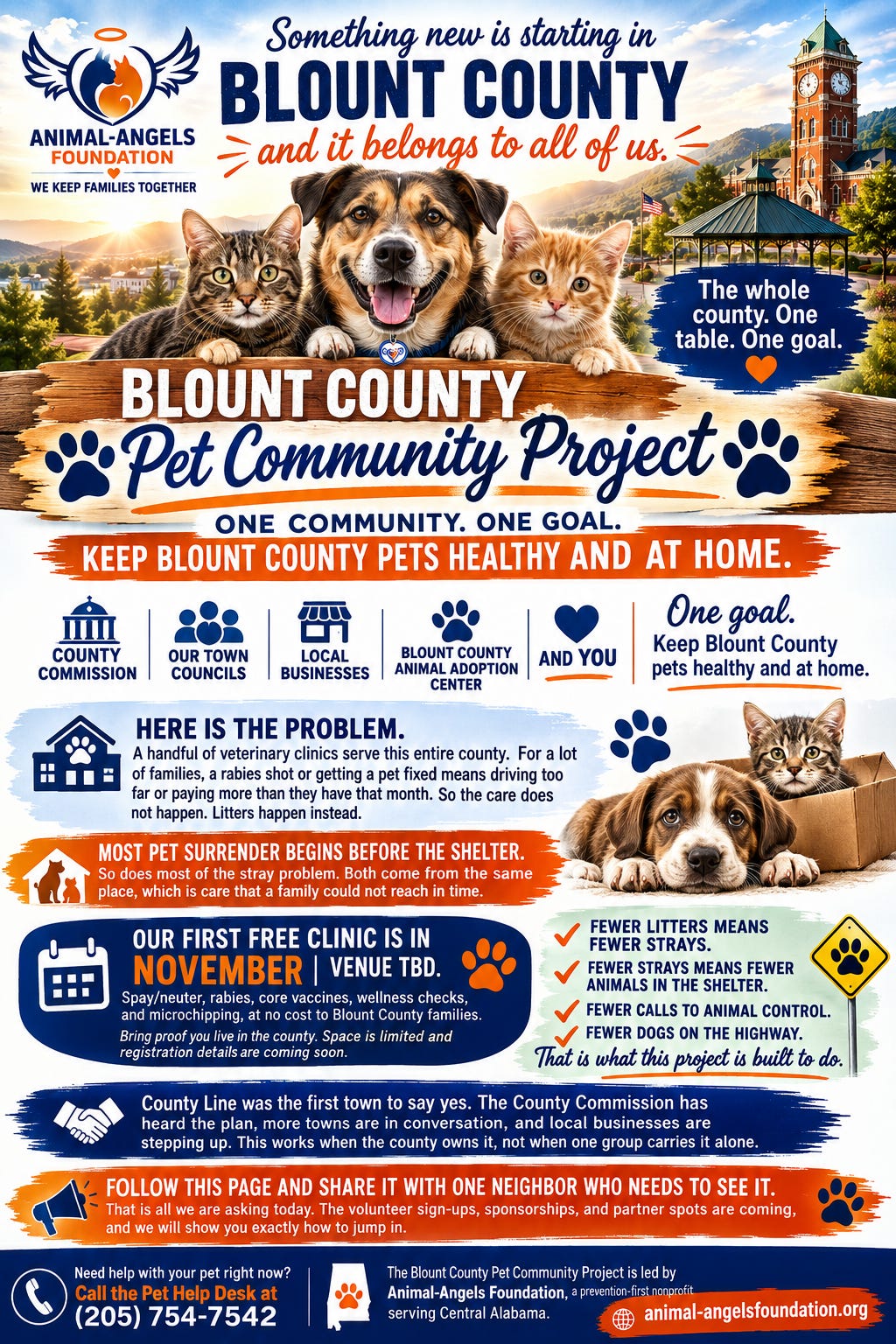
The first is High-Impact Clinics. On a clinic day, a family in Blount County brings a dog or a cat and goes home a few hours later with that animal spayed or neutered, vaccinated against rabies, current on core vaccines, microchipped, and tested for heartworms with prevention started. No cost. No income paperwork. No proving you deserve it. The clinics move around the county on purpose, because the families who need this most are the ones who were never going to drive an hour and take a day off work to get it. The care comes to the neighborhoods instead of waiting on the neighborhoods to come find it.
The second is community cat TNVR, which stands for trap, neuter, vaccinate, return. Between clinics, residents help humanely trap the free-roaming cats in their own communities, get them fixed and vaccinated, and return them where they live. Right now Blount County has no TNVR program anywhere in it. Free-roaming cats are the hardest population on any shelter, and they are the one nobody here has ever had a plan for. The clinics move the numbers for owned pets. TNVR moves the numbers for the cats behind the barn, behind the store, and under the church steps.
What the goal actually is
Ask somebody in this county what winning looks like and nobody answers with a surgery count. They answer with something more like this.
No more dogs dumped at the end of your driveway. No more cats under the porch with a new litter every few months, and another one behind that, and another one behind that. No more shelter packed past capacity every single spring because nothing was ever done to shrink kitten season before it got here. No more good neighbor standing in the yard at dusk looking at a dog somebody left, already feeding six of their own, already stretching a fixed income further than it goes, taking it in anyway because what else is there to do. No more driving past a cardboard box on the side of the road and carrying that box around in your head for the rest of the week.
That is the goal. The surgery numbers are just how you get there.
Spay and neuter only works when it reaches a dose and holds it. About seven to eight surgeries per thousand residents every year, kept up for roughly five years, is where a shelter’s intake starts falling by half. For Blount County that is 420 to 480 surgeries a year. Not once. Every year, for five years. The first two years look like nothing is happening. By year three the curve starts to bend. By year five the intake is cut close to in half.
Huntsville already proved it in this state. Its community spay and neuter funding grew from about $20,000 a year in 2009 to about $100,000 a year today, and over that stretch citywide shelter intake fell from around ten thousand animals to around five thousand, even while the city itself grew. Blount County is aiming at the same result on its own scale, and it will be measured against Blount County’s own shelter numbers, so the county can watch the line move instead of taking anybody’s word for it.
Why the county is behind it
Because a county cannot fix what it does not own. Towns, businesses, churches, civic clubs, and residents across Blount County are stepping into this one because the animals on these roads are Blount County’s animals, and the families who love them are Blount County’s families. Nobody from outside is ever going to care about that more than the people who live here.
And because the alternative never ends. Handling animals after the fact, year after year, does not slow down what is coming in. It just pays for it, forever, at the far end, where it costs the most and helps the least.
Animal-Angels Foundation, a prevention-first nonprofit working across seven Central Alabama counties, is coordinating the project and bringing the veterinary capacity behind the clinics. The project carries the county’s name because that is who it is for and who it answers to.
What it looks like when it works
Here is the strange part about prevention. When it works, almost nobody notices.
There is no photo of the litter that was never born. No headline about the dog that never got dumped on a county road, because his family got him fixed at a clinic in their own town and he is asleep on their porch right now. No story about the spring that came and went without the shelter filling up. The whole measure of this thing, five years out, is a quiet county and a shelter with room in it.
That is what Blount County is building. Not a rescue. Not a one-day event. A county that decided the cycle was going to end here, and then went and did the unglamorous work of ending it.
If you live somewhere else and you are reading this thinking your county needs this, look closely at what made it possible. It was not a big check. It was a county deciding the problem was theirs to solve and then refusing to solve it alone. Animal-Angels Foundation has made the project repeatable for other counties wanting to do the same.
Follow the project, watch for when the clinics are coming to your part of the county, and find out how to help at:
The project donation page is at
animal-angelsfoundation.org/BlountCountyProject.html
or for your own version of the project contact
angels@animal-angels.org
Join the shift to prevention.
Donate to Prevention and fund what happens before the shelter.
Animal-Angels Foundation
angels@animal-angels.org
animal-angelsfoundation.org
Connect with us:
LinkedIn: linkedin.com/company/animalangels
Facebook: facebook.com/animalangelsfoun
Instagram: instagram.com/an.gels377
Animal-Angels Foundation Inc
A 501(c)(3) public charity
Tax ID 41-3166394
We welcome DAF and QCD gifts.
Serving Jefferson, Shelby, Blount, St. Clair, Walker, Bibb, and Chilton counties in Central Alabama.
Pet Help Desk: (205) 754-7542
Email: angels@animal-angels.org
Mail: 4906 Vise Road, Pinson, AL 35126
Web: animal-angelsfoundation.org
Donate: animal-angelsfoundation.org/Donate.html
By Animal-Angels Foundation, a prevention-first 501(c)(3).