


Every time an Alabama city makes the news for a free-roaming dog problem, the same comment lands within the hour.
“Pass a mandatory spay and neuter law.”
The latest is Sylacauga. Before that it was Birmingham. Before that it was every community cat thread and every animal welfare forum where someone is angry. The instinct is right. Too many animals. Too few homes. Something has to change.
But the field that does this work for a living already worked this out. And most of the people demanding the law do not know that Alabama already has a version of it. They are asking for a different version. The version that has failed everywhere it has been tried.
This article exists to fix that confusion.
There are two completely different laws people lump together. Knowing the difference is the only way to think clearly about this.
Law One:
Law one is the one Alabama already has. Alabama Code 3-9-1 through 3-9-4 was adopted in 2006. Every shelter, animal control agency, and humane society in the state must sterilize the dogs and cats they adopt out. Either before the animal goes home, or through a signed thirty-day agreement with the adopter who pays for the surgery and submits the veterinarian’s proof of completion within seven days of the procedure. Noncompliance is a misdemeanor with a fifty dollar minimum fine.
The law is real. It is on the books. It is, like a lot of Alabama animal welfare law, inconsistently enforced. But the law exists.
Law Two:
Law two is the one people are actually arguing about when they say “mandatory spay and neuter.” That phrase is shorthand for a city or county ordinance forcing every owned pet in the jurisdiction to be altered. Not shelter animals. Owned pets. The dog in your yard. The cat sleeping on your couch. Every animal, mandatory.
That is the controversial version. That is the one the animal welfare field has tested and rejected.
When someone says Alabama should pass mandatory spay and neuter, they are not asking for the shelter law. Alabama has the shelter law. They are asking for the owned-pet version. The version that does not work.
Why no one is fighting the shelter law: shelter and rescue adoptions are the end of the line. Those animals produce no future litters. Every organization that opposes mandatory laws on owned pets supports sterilizing shelter animals before adoption. No serious person is on the other side of that question. The fight is about whether the law extends to every privately owned pet in town.
The animal welfare field is not unanimous on much. It is unanimous on this.
The ASPCA finds no credible evidence that mandatory spay and neuter laws produce a statistically significant drop in shelter intake or euthanasia. The American Veterinary Medical Association does not support laws mandating spay and neuter of privately owned, non-shelter pets, because mandatory approaches push owners away from licensing, rabies vaccination, and veterinary care. Best Friends Animal Society opposes them. The Humane Society of the United States opposes them. The American College of Theriogenologists opposes them. The No Kill Advocacy Center opposes them. The National Animal Interest Alliance opposes them.
That is not a fringe position. That is the consensus across every major national organization that touches this work. The progressive ones, the conservative ones, the breed clubs, the rescues, the trade associations for the veterinarians who perform the surgeries. They all looked at the data and reached the same conclusion.
The numbers were worked out in 2010 by Peter Marsh in a book called Replacing Myth with Math. Marsh looked at decades of shelter data and found something that contradicts almost every fundraising appeal ever written. Shelter death reduction has not come from better adoptions. It has come from fewer intakes.
The cities that passed mandatory spay and neuter laws saw intake stay flat or rise. The cities that spent the same money on free, accessible spay and neuter for the families who needed it saw intake fall. Same dollars. Opposite results.
The mechanism is simple. A law without access changes nothing. Access without a law changes everything.
The biggest test happened in Los Angeles. In October 2008 the city passed an ordinance requiring every dog and cat over four months old to be spayed or neutered, with limited exemptions. Two years in, shelter intake had not dropped. The city had spent enforcement resources, generated court cases, and accomplished nothing measurable.
Long Beach and Aurora, Colorado, passed similar ordinances and saw similar results. Most cities that watched Los Angeles decided not to follow.
The reasons the law fails are not mysterious.
The first reason is cost. A family that cannot afford a $150 spay surgery does not suddenly afford it because a city council voted. The law does not change the financial math at the kitchen table. It just adds a fine for the people who cannot pay the original bill.
The second reason is what the AVMA documented. Owners avoid veterinary care to avoid detection. Vaccinations drop. Rabies risk rises. Disease risk to the family rises. Disease risk to other animals rises. Mandatory spay and neuter is not just bad animal policy. It is a public health problem.
The third reason came out of Los Angeles itself. Some private veterinarians raised their spay and neuter prices after the ordinance passed, because the law gave them a captive market. Surgery became less affordable, not more.
This is the part of the argument most people never get to. It does not come up in council meetings because most council members do not know it exists.
A mandatory law assumes the surgeries can happen. They cannot. Not at current capacity.
A 2025 study by Guerios, Clemmer, and Levy looked at 212 high-volume spay and neuter clinics across the United States. The clinics never recovered from the COVID shutdown. They are performing fewer surgeries per quarter than they did in 2021.
A 2024 shelter capacity survey found 73 percent of facilities delaying spay and neuter surgeries because of veterinarian shortages. The same survey counted 18,648 animals on waiting lists for surgeries that were not happening fast enough.
Rural areas have become veterinary deserts. Whole counties have no clinic within an hour’s drive. The surgery you would be legally required to obtain does not have an appointment available.
A law cannot mandate a procedure that has no available appointment. What it can do is manufacture a violation. The animal is unaltered because the system has no capacity to alter it, and now the owner is in trouble for a problem the system created.
There is no enforcement model that makes this fair.
An animal control officer cannot tell by looking whether a pet is altered. So mandatory spay and neuter only surfaces when an animal is impounded for some other reason, or someone files a complaint. It becomes a secondary charge stacked onto a family that is already in crisis.
Look at the four groups of pet owners in any community.
Show owners get written exemptions because purebred breeding is the original carve-out in every version of this law. Owners who oppose the law on principle find their way to exemptions, religious or otherwise. Responsible owners who can afford the surgery already had it done. The only group left to enforce against is the families who cannot afford it.
That is who the law catches.
Enforcement also pulls animal control resources away from the things animal control should be doing. Getting lost pets home. Responding to bites. Handling cruelty cases. Time spent chasing unaltered pets is time not spent on public safety.
The reader comments tell the story plainly. Mandatory laws hit hardest the people who need help most. The families that already make harder choices than anyone reading this article will ever make.
Forced compliance pushes those families toward dumping or surrendering the pet they cannot legally keep. That is the exact opposite of the goal. The pet enters the system. The shelter takes another animal. The taxpayer pays for the housing, the food, and often the euthanasia. The family loses an animal they loved.
There is also a deeper problem. Mandatory spay and neuter gives authorities a tool to separate low-income families from their pets. The animal is unaltered. The family cannot pay. The animal is removed. Sometimes the rationale is welfare. Sometimes it is just a citation that escalates.
At best, mandatory laws on owned pets are unnecessary because access programs do the same job better. At worst they break families apart.
Every program that actually moves the numbers does the same thing. Access, not mandate.
Pets for Life is the model. The Humane Society of the United States program goes door to door in high-intake neighborhoods. Surgery is free. Vaccinations are free. Transport is handled. The veterinarian appointment is made for the family, not by the family. Compliance is around 90 percent. The reason it works is partnership. Knock on the door. Listen. Help.
Mandatory laws do the opposite of partnership. They drive a wedge into exactly the community relationships that prevention depends on. Ask any animal welfare professional who has tried to build trust in a neighborhood where a mandatory law was already on the books. The first conversation has to undo the law before any real work can start.
The numbers on what works are clear too. Fort Wayne Animal Care and Control runs a measured 31 percent intake diversion rate. Best Friends Animal Society reports a practitioner benchmark of 33 to 50 percent for intake diversion programs done well.
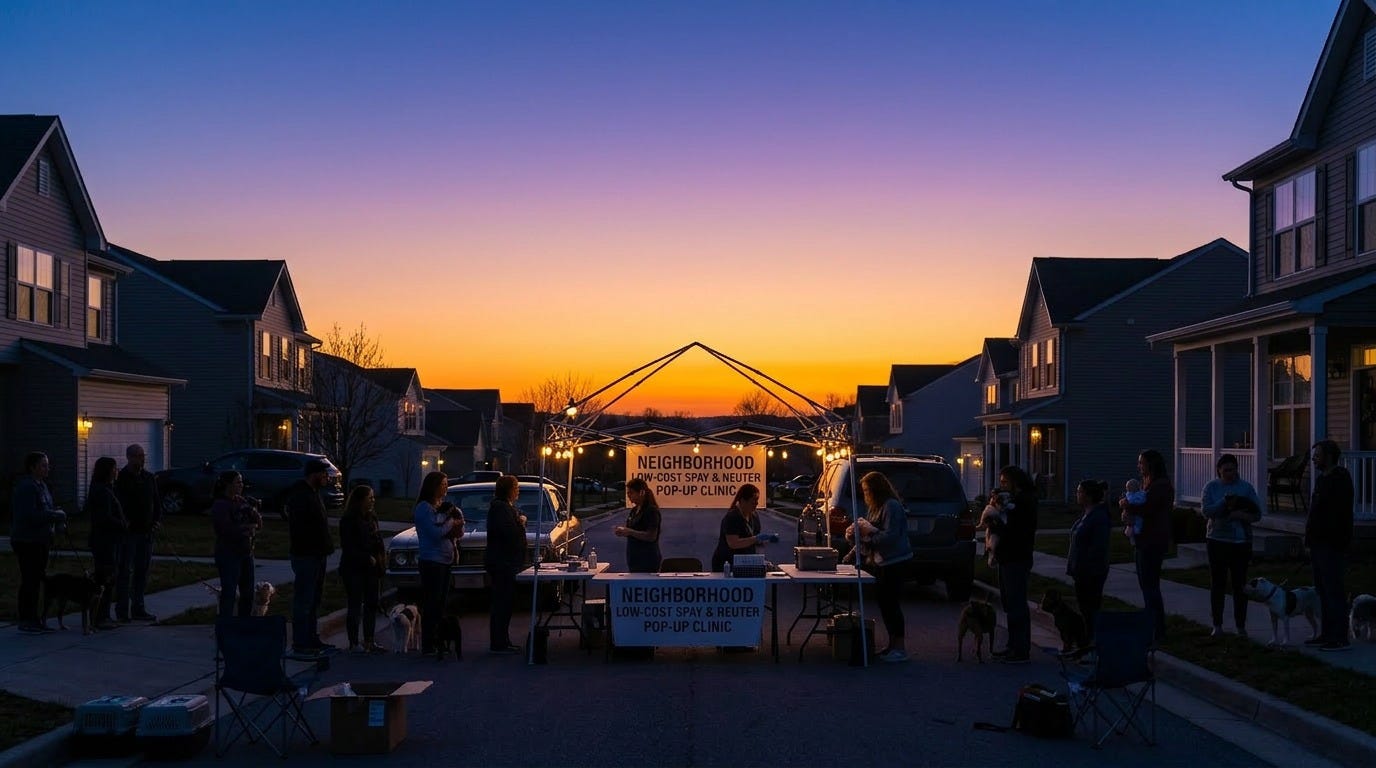
If a community wants to use a legal lever, the one that helps is incentives, not mandates. Reduced licensing fees for altered pets. Free clinics paid for through the licensing differential. The carrot, not the stick.
The strongest argument against mandatory spay and neuter in Alabama is that another Alabama city already proved access works.
In 2009 Huntsville started Fixin’ Alabama with a city budget line of $20,000 a year for free and reduced-cost spay and neuter. The investment grew over time. The city now puts $100,000 a year into the program.
Intake at the Huntsville city shelter fell from roughly 10,000 animals a year to about 5,000, while Huntsville grew into the largest city in Alabama by population. More people, more pets, half the shelter intake. No mandate.
Then there is the bottleneck nobody on a city council talks about. Alabama has four nonprofit spay and neuter clinics. Four. In a state with sixty-seven counties.
A mandatory law does nothing about that. A mandatory law cannot create a clinic. A mandatory law cannot train a veterinary technician. A mandatory law cannot put a building on the ground in a rural county.
Funding access can.
The cities watching this play out right now are Sylacauga, Birmingham, and every Alabama city debating a free-roaming dog problem this year.
The choice is at the council level. Pass a mandatory spay and neuter ordinance and watch shelter intake stay flat for the next two years. Build an access program and watch intake fall like it did in Huntsville. Alabama already proved which one works.
Two laws. One state. The shelter law works. The mandatory law fails every time.
The next time someone shows up at a city council meeting demanding mandatory spay and neuter, ask which version of the law they mean. If they mean the one that already exists, point them to the statute. If they mean the one that has been tested and rejected nationwide, hand them the numbers from Huntsville.
The numbers do the work the law cannot.
Most pet surrender begins before the shelter. Prevention is the missing piece. Mandatory laws on owned pets are not prevention. They are punishment with a permit attached.
Build the access program. Fund the clinics. Knock on doors. The intake will fall.
Alabama already proved it.
Sources
Alabama Code 3-9-1 through 3-9-4, Sterilization of Dogs and Cats. Adopted 2006.
ASPCA. Position Statement on Mandatory Spay/Neuter Laws.
American Veterinary Medical Association. Policy on Dog and Cat Population Control.
Marsh, Peter. Replacing Myth with Math: Using Evidence-Based Programs to Eradicate Shelter Overpopulation. Town and Country Reprographics, 2010.
City of Los Angeles. Mandatory Spay and Neuter Ordinance, effective October 2008.
Guerios, S., Clemmer, G., and Levy, J. Decline in Spay-Neuter Capacity Following the COVID-19 Pandemic. Frontiers in Veterinary Science, 2025.
2024 Shelter Capacity and Veterinarian Shortage Survey. (Verify exact citation before publishing: Shelter Animals Count, AAWA, or Maddie’s Fund report depending on source used.)
Fort Wayne Animal Care and Control. Public Intake and Diversion Reports.
Best Friends Animal Society. Humane Animal Control Manual. (Practitioner intake-diversion benchmark, 33 to 50 percent.)
Humane Society of the United States. Pets for Life program data. (Door-to-door access model, approximately 90 percent compliance.)
City of Huntsville. Fixin’ Alabama program budget records.
Kavanaugh, Aubrie. Paws4Change. No, Mandatory Spay/Neuter Is Not the Answer.
Every post in this newsletter is free. We do not paywall the field. If you want to fund what happens before the shelter, the donate link is in the footer of every email.