


UPDATE, July 25, 2026: Sylacauga adopted this ordinance on July 21, and the final version is much narrower than the draft analyzed below. It applies to feral dogs only, not cats and not "feral animals." It covers the Highway 280 Business Corridor, not the whole city. And the first offense is a written warning, not a fine. The community cat and TNVR concern this piece was built on is not in the law they passed. I told a Sylacauga council member I would update this if the final ordinance dropped the cats. It did, so here is the update. The analysis below was written about the earlier draft and I am leaving it up as the record of what was on the table. The prevention argument has not changed: most of the intake is still regional, the twenty-five thousand dollars still died on one vote, and the front-end math still buys more than the back end ever will.
Two months ago I wrote about Sylacauga because the city was deciding what to do about a pack of dogs on Highway 280. The proposal in front of the council involved foothold traps, sedation through baited food, and lethal removal with suppressed rifles and thermal scopes. The public showed up. The company behind it withdrew the proposal before a vote. Council President Tiffany Nix said afterward, on the record, “I do think we probably moved a little bit, we moved too fast. We didn’t know what we were doing, and I’m just glad the public did chime in.”
That was an honest thing for an elected official to say out loud.
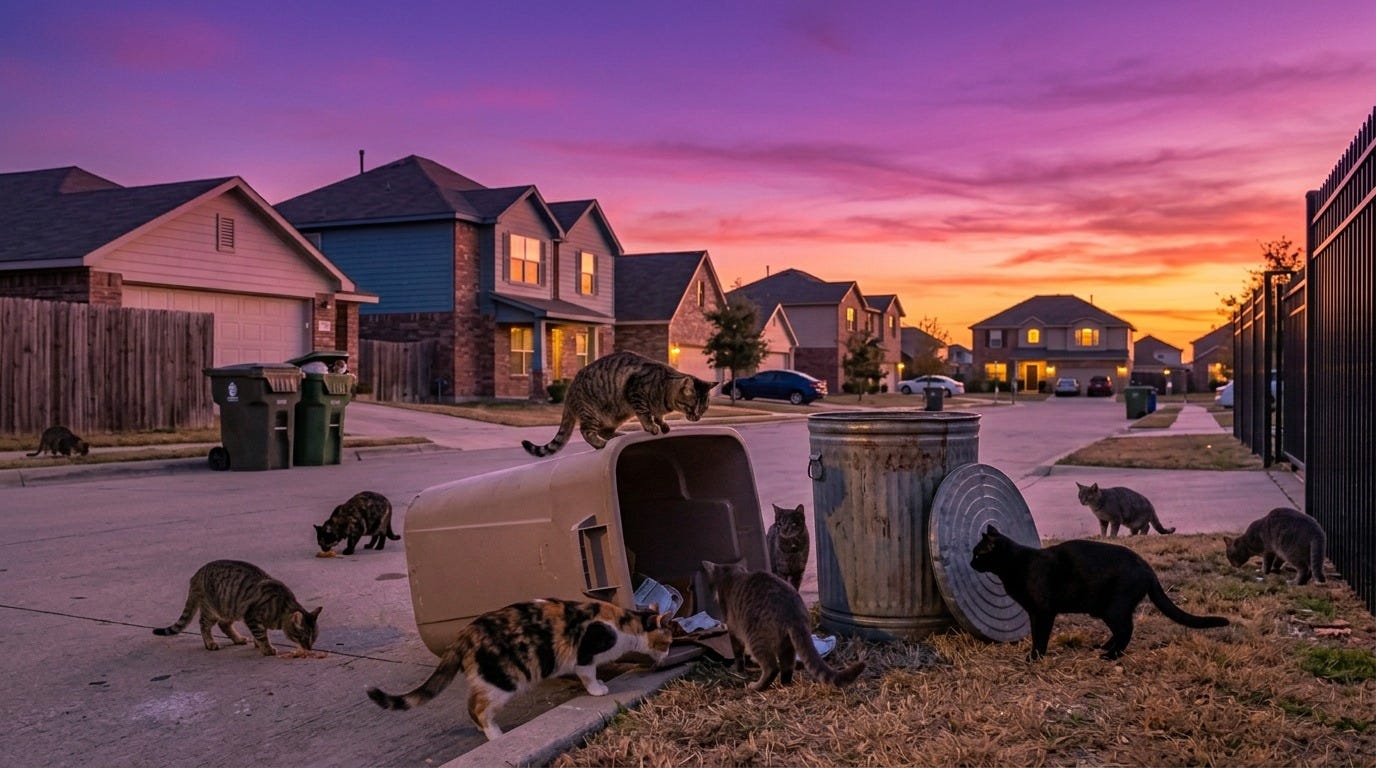
Now there is a draft ordinance circulating in Sylacauga that would prohibit feeding feral animals anywhere inside the city. Dogs, cats, pigs, anything the ordinance defines as a member of a domesticated species that has escaped captivity or been abandoned. Minimum fine of two hundred dollars. Each day counts as a separate violation. Up to six months in jail or at hard labor.
I understand the impulse on the dogs. I want to talk about the cats, because the people who drafted this do not appear to have considered them at all, and because the ordinance as written does something none of its authors intended.
The ordinance argues against itself
Read Section 3(b). No person shall feed any wild or feral animal “which is not owned by such person” without written permission from the title owner, carried on your person.
Now read Alabama Code Section 3-7A-1(9), the definition of owner in the state rabies statute. An owner is any person “having a right of property in a dog, cat, ferret, or other animal, or who keeps or harbors the animal, or who has it in his or her care, or acts as its custodian, or who permits the animal to remain on or about any premises occupied by him or her.”
Five routes to ownership. Four of them have nothing to do with title. Feeding a cat every day is harboring it. It is having it in your care. And if the cat lives behind your building, the fifth route closes on its own whether you ever put out a bowl or not.
So the ordinance forbids feeding animals you do not own, and state law says the act of feeding is one of the things that makes you the owner. A woman who has fed the same six cats behind a Sylacauga strip mall for four years is, under Alabama’s own definition, already their owner. Which means she is also already in violation of Section 3-7A-2(a), which requires every owner to vaccinate against rabies, with no exception for feral or community cats and no carve-out for TNVR.
No Alabama court has ruled on whether a feeder is an owner under that section, so this is an argument and not a settled question. But it is the argument a city attorney should have run before drafting Section 3(b), and the direction it points is the opposite of the one the ordinance wants to go.
Then there is Section 3(c), which prohibits leaving or storing “any refuse, garbage, food product, pet food or forage product in a manner that would constitute an attractant.” Read literally, that is a trash can. Sylacauga has about 12,055 residents as of the Census Bureau’s July 2025 estimate. The ordinance would put a meaningful share of them in technical violation on garbage night, and then leave it to whoever calls in a complaint to decide which one of them gets the two hundred dollars.
This is a public health argument that runs backward
Feeding bans get sold as public health measures. Rabies is the word that does the selling.
Here is what actually happens. The people feeding community cats are the only people in the county who know where those cats are, how many there are, which ones are new, and which ones are sick. They are also the only people positioned to get a trap on one. Every TNVR program in this country runs on the fact that a hungry cat returns to a known food source at a known time. That is not a side effect of feeding. That is the mechanism.
Ban the feeding and you do not remove the cats. You remove the census. The cats stay, unfed, unvaccinated, uncounted and untracked, and the one person who could have told the city where they were now has a fine and a good reason never to call city hall again.
That is a worse rabies posture than the one Sylacauga has today, and you can argue it straight off Alabama’s own statutory scheme.
Nobody has ever shown one of these works
I went looking for a single jurisdiction anywhere in the United States that enacted a cat feeding ban and then published data showing colony populations fell. There is not one. Not one city, not one county. Both sides of this fight assert outcomes and neither has produced numbers. When Miami-Dade drafted its version in 2025, the county’s own language said prohibition “may decrease their populations over time.” May. That is a county attorney guessing, and the measure was withdrawn before it ever got a hearing.
Antioch, California tried one. In 2014 the Mercury News reported the result under the headline “Antioch feral cat feeding ban proves futile.”
There is also a scale problem nobody thinks about at a council table. Surveys put the share of Americans who feed cats they believe to be stray somewhere between 10 and 26 percent, depending on the study. Sylacauga has roughly 12,055 residents and an animal shelter staffed by five people. Even at the bottom of that range, this ordinance would create a class of offenders in the four figures and assign a handful of employees to go find them.
What does exist is a record of what enforcement looks like in practice.
In Garfield Heights, Ohio, Nancy Segula was cited in 2015, cited again in 2017, and in 2019, at seventy-nine years old, sentenced to ten days in jail for feeding stray cats. A judge vacated the sentence after the story went national.
In Swanton, Ohio, a man was cited in March 2026 for feeding cats during a winter cold snap and assessed a hundred dollars in court costs. Reporting indicates the judge was surprised the ordinance existed. Within days of the coverage the mayor suspended enforcement, and the council later approved a TNVR program instead. The ban is still in the code.
In Hawai’i County, public testimony on its 2025 feeding ban ran 454 opposed to 25 in support. It passed anyway, took effect January 1 of this year, and has published no enforcement data since.
The pattern is not subtle. Enforcement is complaint-driven, it lands on elderly women, and it collapses the moment anyone outside the city looks directly at it.
The association whose members would actually have to enforce this has a written position. The National Animal Care and Control Association: “Feeding bans are not effective strategies for dispersing congregations of cats or mitigating complaints.” Humane World for Animals puts it to municipal leaders more plainly still: “People who feed cats will ignore the ban, even at great personal risk, and enforcement is extremely difficult, resource intensive and unpopular.”
Wetumpka is forty minutes away
In June 2022 the City of Wetumpka arrested two women who were feeding and trapping cats for TNVR on public property. Beverly Roberts was eighty-five and a retired Army sergeant major. Mary Alston was sixty.
Wetumpka had no feeding ban. Feeding cats there was legal. So the city reached for its criminal trespass ordinance instead, barred the women from the property, and arrested them when they came back. Both were convicted in municipal court. On appeal, with a jury trial demanded, the city dismissed every charge. The women filed a federal civil rights suit, and in May 2024 the Wetumpka City Council voted to settle for not more than fifty thousand dollars.
That case settled, which means it set no legal precedent, and I am not going to pretend otherwise. What it set was a price. An Alabama city spent up to fifty thousand dollars and two years of statewide coverage on a fight it picked over cat food, and it did not even have a feeding ban to work with. Sylacauga is considering handing itself a much sharper instrument than the one Wetumpka used.
Know somebody running an animal control budget, a foundation grant cycle, or a shelter intake desk? Send this. They are the ones who decide whether the next five years look like the last five.
Removing cats does not produce fewer cats
The science here is genuinely mixed and I am not going to oversell my side of it.
What is solid is that in open populations, taking cats out triggers fast repopulation. Researchers removed an estimated 44 percent of the cats from a New Caledonia peninsula in a 2020 study, and every camera-trap measure of abundance and density had returned to pre-culling levels within three months. A thirteen-month Tasmanian study found the number of cats known alive rose 75 percent at one culling site and 211 percent at the other while culling was underway, then fell back toward baseline once culling stopped. The mechanism is immigration into the opened territory, plus reproductive rebound, plus people continuing to abandon owned cats.
The honest caveat is that removal does work on closed populations. Island eradications have succeeded. But no mainland Alabama city is a closed population. Sylacauga sits on Highway 280 with unincorporated Talladega County on every side of it.
What is also solid, and this one cuts against my own argument, is that scattered part-time sterilization does not reduce populations either. A twelve-year controlled study in urban Israel, published in PNAS in 2022, found neutering only reversed population growth when it was intensive, geographically contiguous and sustained above roughly 70 percent of the population. Below that threshold, compensatory effects ate the gains. Three separate population models put the number somewhere between 70 and 94 percent.
That is the actual finding and it is not a talking point for either camp. Doing this halfway does not work. Doing it seriously does. A feeding ban is not even halfway.
It is worth noting where that Israeli study turns up. The 2022 commentary urging governments to ban outdoor cat feeding sites cites it as that paper’s own single example of a successful population reduction. The one intervention that worked, in the argument for feeding bans, was a citywide sterilization program.
Los Angeles already ran this experiment
In 2008 a conservation coalition sued the City of Los Angeles over its TNR program. The city lost. From December 2010 until 2020 an injunction barred Los Angeles from supporting TNR in any form, down to the point that city employees could not refer a resident to a nonprofit that did it.
That is about as close to a controlled experiment as this field gets. A major American city was ordered to stop doing the thing Sylacauga is considering discouraging, and then ran that way for most of a decade.
Los Angeles Animal Services intake of young kittens went from 8,818 in 2010 to more than 13,000 in 2019.
I want to handle that pair of numbers carefully, because they reach me through Best Friends Animal Society’s account of city data rather than through a peer-reviewed evaluation, and Best Friends is not a neutral party in this fight. But the direction is not ambiguous and nobody has put forward a competing account. Shut down the sterilization and a decade later the kittens arrive at the shelter door instead.
One more thing, for anyone making the wildlife argument
The case for feeding bans usually arrives wrapped in bird conservation. Cut off the food, save the songbirds.
The research points the other way. Silva-Rodriguez and Sieving, in Conservation Biology in 2011, found that the level of care a domestic carnivore receives influences how much it preys on vertebrates. Cove and colleagues, studying free-ranging cats in the Florida Keys and publishing in Biological Invasions in 2018, found the same pattern in what those cats were actually eating.
A fed cat hunts less than a hungry one. Take away the bowl and you have not removed a predator from the landscape. You have removed its alternative to hunting.
What Sylacauga’s own numbers say
The most useful fact in this entire file came from Sylacauga’s own mayor. At the May 6 council meeting, Mayor Matt Hubbard said 70 percent of the dogs the city’s animal control officer brings to the shelter come from outside the City of Sylacauga.
Sit with that number. Seventy percent of the load is regional. Talladega County pays the city twenty thousand dollars a year to shelter animals from a three-mile unincorporated strip. The county operates no animal control of its own in unincorporated areas.
Meanwhile the city’s reclaim rate collapsed. In 2024, thirty-five of 687 impounded animals went home to their owners. In 2025, six out of more than seven hundred. The live release rate fell from 67.2 percent to 58.4 percent across that same year. On May 5 the council failed to pass a twenty-five thousand dollar line item to respond to the feral dog situation, because the resolution required unanimous consent and one member voted against it. At that same meeting the council approved $29,999 for a shelter van.
That is not a city with a feeding problem. That is a city absorbing a county-sized caseload on a city-sized budget, with no regional funding mechanism, no county animal control to hand anything off to, and a reclaim rate near zero.
A feeding ban does not touch any of that. It cannot. It is aimed at the only group of people in Sylacauga voluntarily doing unpaid population work, and the thing it would most reliably reduce is not the number of cats in the city. It is the number of cats anyone can see.
What the money buys at the other end
On May 5 the Sylacauga council could not pass twenty-five thousand dollars to address its dog situation. Hold that number and run it through the front end instead.
Twenty-five thousand dollars through a spay/neuter program, priced at what it actually costs us to deliver one, funds about 125 sterilizations. Those surgeries prevent roughly 563 shelter intakes, because sterilizing an animal does not prevent one animal. It prevents the litters that animal would have produced, and the litters after that. Against a first-month shelter cost of nine hundred dollars per animal, that is somewhere near $506,700 in cost that never lands on the city, and about 7,900 shelter days that never happen.
Run the same twenty-five thousand through a triage line that reaches families before they surrender and it stretches further still, because a phone call costs less than a surgery.
I want to be plain about where those figures come from, since this whole piece is an argument about rigor. The nine hundred dollar intake cost is our model, built from a fourteen-day average stay at thirty-one dollars a day plus intake processing. Reasonable people price it differently. Most municipal shelters cannot price it at all. Charlotte’s own internal auditor reported in March of this year that the city’s animal care department had no cost-per-animal metric and committed to begin reporting one by the end of July. Sylacauga does not appear to have it either, and that is part of the problem.
Cut our figure in half and the shape of it does not change. The twenty-five thousand dollars that died on a single dissenting vote was worth several times its own value if it had been spent eighteen months ahead of the problem instead of on top of it.
That is the entire argument, and it has nothing to do with whether anyone likes cats. A dollar spent at the back end handles one animal one time. The same dollar spent at the front end buys you the animals that never arrive.
What I would put in front of that council
I sent the Sylacauga City Council a formal prevention recommendation in May. I will send them this one too, so here it is in public first.
Do not pass Section 3. If the concern is sanitation, Sylacauga already has nuisance and sanitation ordinances that address unsanitary feeding without creating a new crime, and Humane World’s municipal guidance recommends exactly that. Using what you already have costs the city nothing.
Write a TNVR exemption before you write anything else. Illinois has model language that exempts registered caretakers from ownership status. Vestavia Hills already has an Alabama feral cat ordinance on the books. Neither of those requires Sylacauga to invent a single thing.
Then go get the county. Seventy percent of the intake is arriving from outside the city limits and the county is paying twenty thousand dollars for it. That is the real budget conversation, and it has nothing to do with anyone’s cat food.
The city has not signed anything yet. The Greater Birmingham Humane Society proposal was pulled from the July 7 agenda without a vote. That seat is still open, which means the direction is still open too.
Sylacauga did not have a dog pack problem. It does not have a feeding problem either. It has a prevention problem and a regional funding problem, and neither one gets solved by fining a seventy-year-old woman two hundred dollars a day for setting out a bowl.
If one person in your life is still arguing that removal and enforcement will fix this on their own, send this. Either the math changes their mind, or they have to explain why it doesn’t.
Join the shift to prevention.
Donate to Prevention and fund what happens before the shelter.
BJ Adkins
Founder
Animal-Angels Foundation
angels@animal-angels.org
animal-angelsfoundation.org
Connect with us:
LinkedIn: linkedin.com/company/animalangels
Facebook: facebook.com/animalangelsfoun
Instagram: instagram.com/an.gels377
Animal-Angels Foundation Inc
A 501(c)(3) public charity
Tax ID 41-3166394
We welcome DAF and QCD gifts.
Serving Jefferson, Shelby, Blount, St. Clair, Walker, Bibb, and Chilton counties in Central Alabama.
Pet Help Desk: (205) 754-7542
Email: angels@animal-angels.org
Mail: 4906 Vise Road, Pinson, AL 35126
Web: animal-angelsfoundation.org
Donate: animal-angelsfoundation.org/Donate.html
By Animal-Angels Foundation, a prevention-first 501(c)(3).